House in Kohoku by Torafu Architects

| 23 comments

hysg_d16.jpg

Tokyo-based architects Torafu have designed this family home in Yokohama, Japan.
hysg_d4.jpg

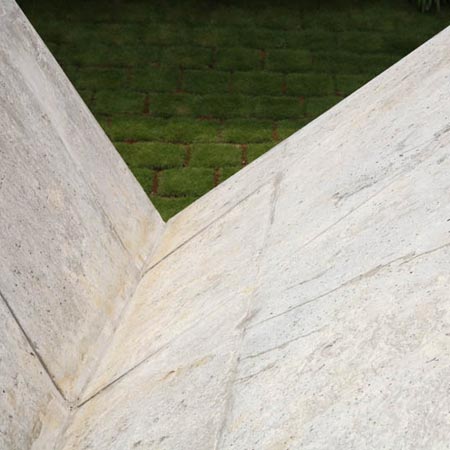
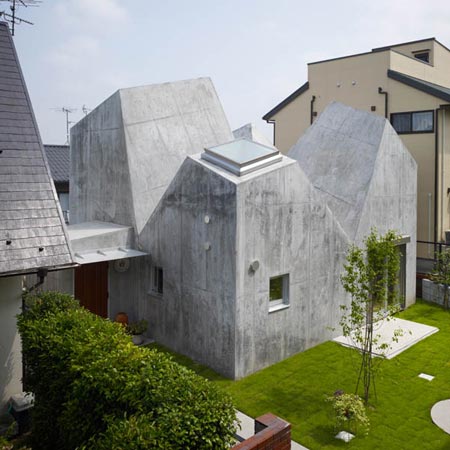
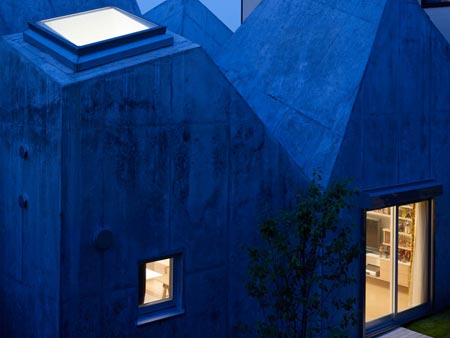
The one-storey house, in the hilltop suburb of Kohoku, is made of cast concrete.
hysg_d7.jpg

Photographs by Daici Ano.

Here's some more information from Torafu:

--

House in Kohoku

This site is located in a quiet residential region reclaimed on a hill of Yokohama. With neighboring houses lined very close together, this flag-shaped site meets a road at a verge of no more than 3 meters in width.

hysg_d6.jpg

Since the site is tilted to the north, and the neighboring house to the south is two-storied and built on a higher ground, at first it seemed almost impossible to let in light from the south, although the client, a married couple who has lived in this place for a long time, wanted a small but sunshiny house of one-story just as their child became independent from them.
hysg_d11.jpg

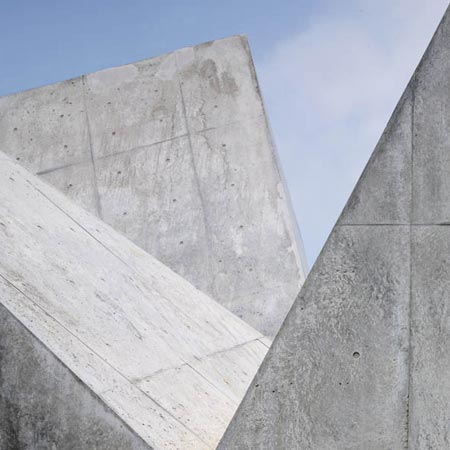
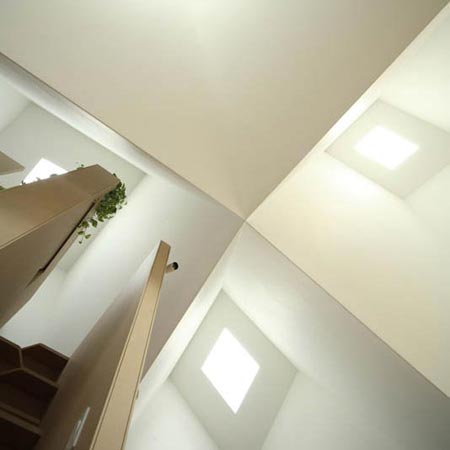
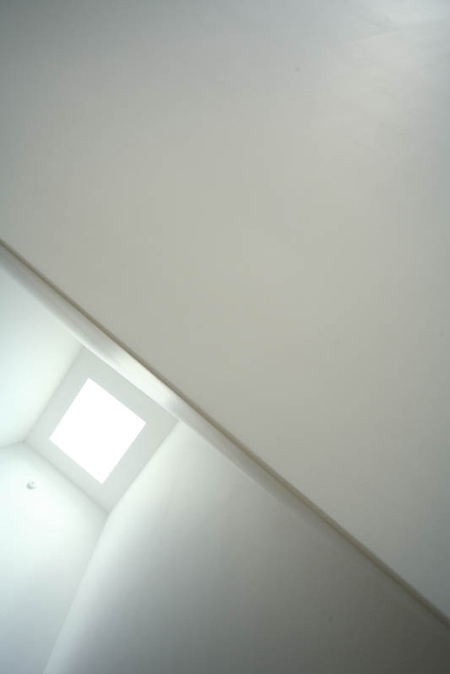
The roof which looks as if barnacled lets in light through the glass on the top of the tube-shaped windows that are set avoiding shades and eye gaze of the neighbors. On the inside of the house clearly appear the shapes of these "tubes" and the arris of a kind of folded plate roof softly separate the whole residential space.
hysg_d81.jpg

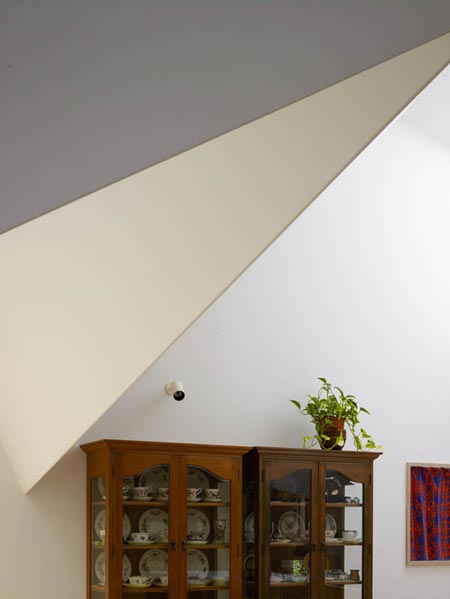
The house being one-storied, we were able to form the roof with freedom. And taking advantage of the freedom, we aimed to make the exterior and the interior appear as two sides of the same object.
hysg_d3.jpg

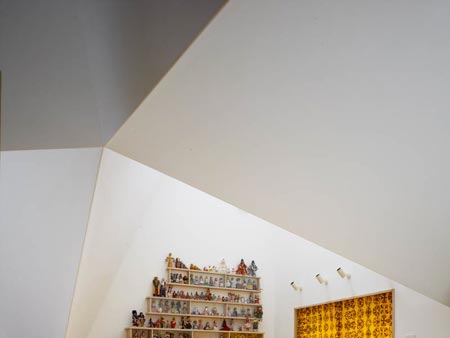
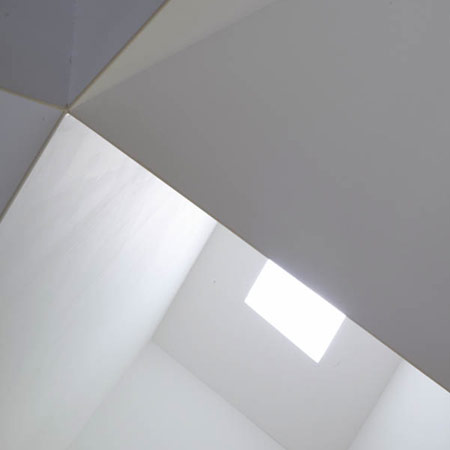
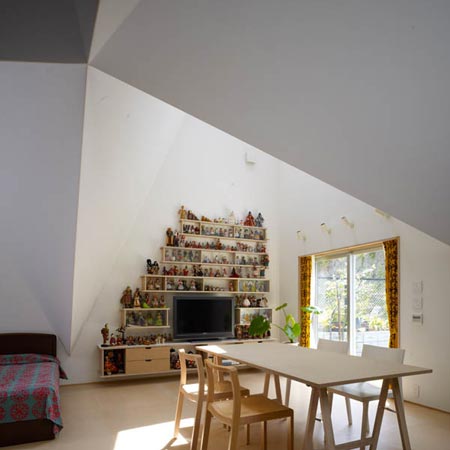
Although the main living area is no larger than approximately 7.5 x 7.5 meters, we tried to give appropriate distance among the scenes of food, clothing and housing by moderately separating every space along the arris of the ceiling and by making the most of the height of the ceiling itself. High arris connect neighboring spaces, and low arris separate them into, for instance, a living room and a bedroom.
hysg_d12.jpg

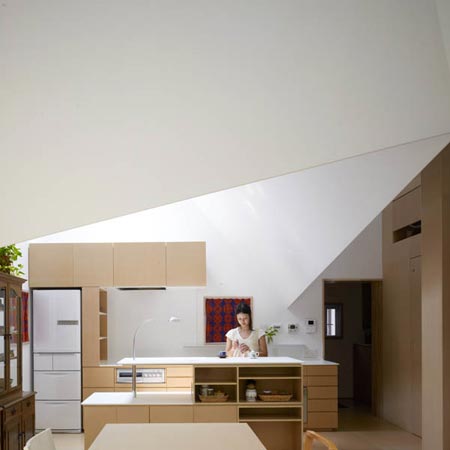
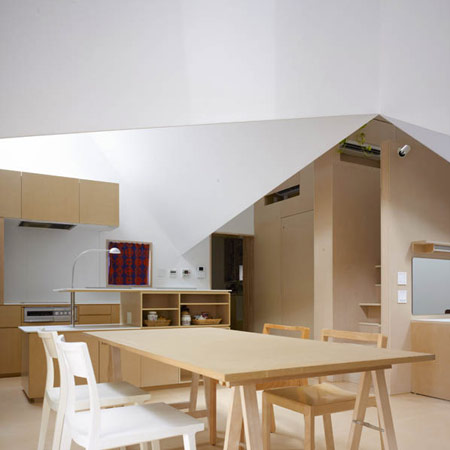
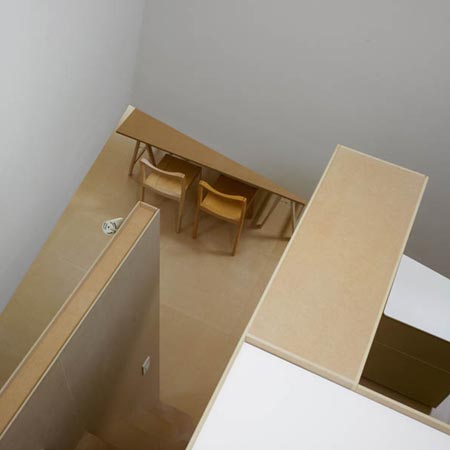
Infixed at the space where the ceiling is highest is a wooden mass. Inside the mass are a kitchen, bathroom and sanitation facilities, while the top of the mass is used as a designing office for their son. The top of the mass, which is a lot like a loft, and other spaces are visually separated but family members presence can be felt when they are there.
hysg_d10.jpg

We decided that we used reinforced concrete, and we sought to use it most reasonably. By giving the roof a kind of folded plate roof structure, we were able to fulfill the pillar-less interior space.
hysg_d5.jpg

As opposed to the concrete substrate surface of the exterior, the walls and the ceiling are painted white and given a bright and homogenous finish.
hysg_d14.jpg

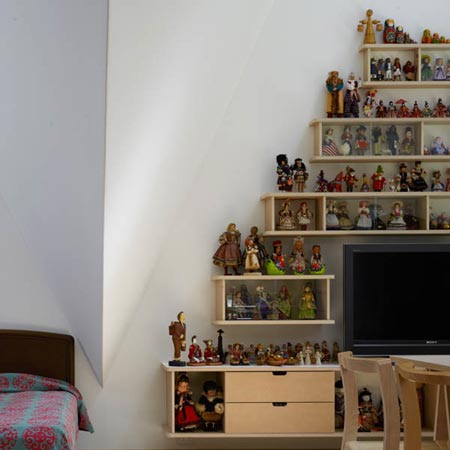
The floor and the built-in furniture are made of medium-density fiberboard and given a paint finish. In stark contrast to the white walls and ceiling, the furniture exists as if it has grown from the floor.
hysg_d151.jpg

The roof not only lets in light and provides cover from rain but, on the inside, gives the space a moderate separation. The brightness and softness of light differs according to season and time of day, which changes the look of the place. The windows on the roof cut out the sky and constantly project the changes of the nature.
sizedhysg_104.jpg

hysg_d17.jpg

hysg_d2.jpg

One Response to House in Kohoku by Torafu Architects

  1. tito says:

    delightful!
    although i think interiors could have been better resolved

  2. rajul mohandis says:

    don’t start climbing the stairs on the wrong foot! =) hahaha

  3. jed_ says:

    it would have been wonderful had it had bigger & more interesting windows. i still like it though.

  4. Magna_Carta says:

    japan and tokyo are remarkable.

    if only britain and london had the opportunity for individual housing – rows of victorian terrances will never inspire such creativity as there

    i think the interiors could change to concrete quite easily for a successful solution

  5. nique says:

    this is horrible! its not comfortable to live in!!

  6. kingmu says:

    I’d live in this in an instant. A structure for the age.

  7. Jeremiah says:

    “this is horrible! its not comfortable to live in!!”…

    So you live there? Why is it uncomfortable? How can you tell from a handful of pictures. Making quick judgments like this, particularly about the experience of space, are asinine. Yes, we can say something looks good or bad from photos. We can question design decisions. The one thing we can not do is comment on the experience of a space, or even of a lamp.

    As for living there, it LOOKS like a very simple living arrangement, and there is nothing wrong with that, we could all probably use simplicity these days.

  8. addict says:

    lovely tiny concrete thing. @nique: sorry but it seems to be a very homelike atmosphere in there if you trust the images

  9. K. Rimane says:

    clearly a failed attempt to seduce.
    the occupant of this house have no knowledge of interior design. the way it is decorated spoils everything else.
    In a few years people will look at this how and wonder “what were they thinking”
    originality = 6/10
    architectural = 6.5/10
    interior = 0/10
    overall = 3/10

  10. critical cow says:

    Some plans would be useful.

  11. pool says:

    House in Kohoku by Torafu looks great !!!!!!!!!!!!!!!!!!!!!!!!!!!!!
    interesting work!!!!!!!!!!!!!!!!!
    is it just one room? or is there divided spaces?
    i want to know more imfomation .

  12. A.S. says:

    It looks like a concrete bunker, horrible shape…. the interior has potential.

  13. edward says:

    So whose idea was the china cabinet. Seriously, I like the use of painted MDF and concrete, so elemental. But the intrusiveness of the ceiling is too much for me. Nice to she the Japanese are willing to accept such a radical design-client and neighbors.

  14. Stefan says:

    not sure… what is interesting about this one? the roof topography?? to be honest it doesnt affect the spaces in a positive way… so whats the reason for this roof?

  15. kingmu says:

    of all the architecture blogs i visit, this has got to have the most rude, nasty, crude comments of them all. it’s so frustrating to read so many negative comments meant only to uplift the author of the negative comment. for me, i simply feel lucky to be able to review all these various spacial concepts and efforts by so many in one place—whether i like them all is of little importance.

  16. copycat ltd says:

    as a chinese, i would like to point out that we don’t like to live under the triangular/razor sharp ceiling. It will cause some psychological bad feeling(yes we call it Feng Shui)…….

    I adore the purity of Japanese architect, it’s a touch of Zen

  17. cicada says:

    Feel home.

  18. mitch says:

    copycat, maybe they did that roof because they knew for your mentioned reason you wont copy it? ;-)

  19. raúl says:

    it looks like living in the montains. i think it could work as kindergarten

  20. dag says:

    I don’t know why, but they deleted my comments before… This project is a good architecture project… and it seems to be that dezeen is only interested in the yellowpress like comments like: WOW, GREAT, LOVE ZAHA OR HORRIBLE ETC…

  21. hana says:

    love the shape.like it has grown out of the fresh green grass and no earthquake is going to push it over.

  22. One says:

    Chinese are funny people. Japanese projects are too beautiful, to be meaningful. Hard to imagine a house where you have little chance to plan your family. In this sense this house is more of an appartment rather than a house. Concrete? Well its hard and heavy. It looks like WWII bunker which was never built in Japan. Strange association to western masonary house? How ese can we explai this? A better energie usage? Not really. But Imust say, without al those rationalization, it looks very beautiful.

  23. Salvadore says:

    i think this is one of the best house i saw on dezeen, just like parr house, i like the roof windows. this house make me feel the catharsis!

Leave a Reply

Your email address will not be published. Required fields are marked *

*

You may use these HTML tags and attributes: <a href="" title=""> <abbr title=""> <acronym title=""> <b> <blockquote cite=""> <cite> <code> <del datetime=""> <em> <i> <q cite=""> <strike> <strong>