Phoenix Observation Tower by BIG
Danish studio BIG has designed an observation tower shaped like a honey dipper for Phoenix, Arizona (+ slideshow).
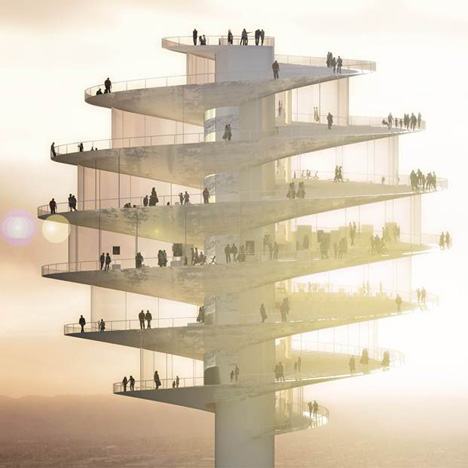
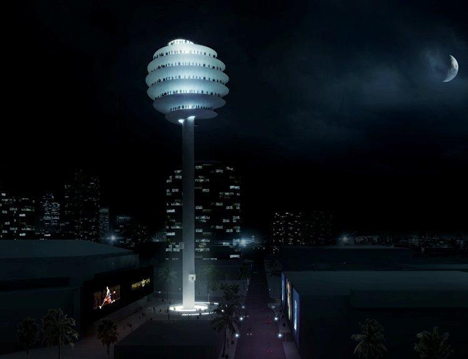
Rising above the downtown city rooftops, the spiralling structure is conceived as a tourist attraction that will contain a continuous series of exhibition spaces, shops and restaurants.
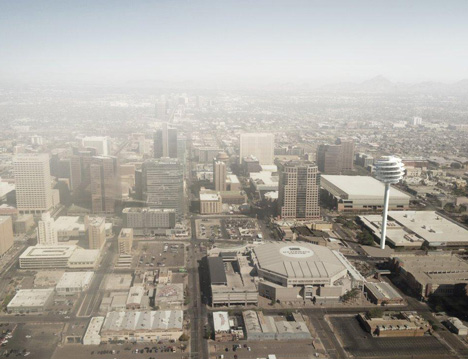
BIG has nicknamed the structure "The Pin" and the designs show a reinforced concrete tower with three glass elevators to transport visitors from the base of a narrow stalk to the summit of the sphere.
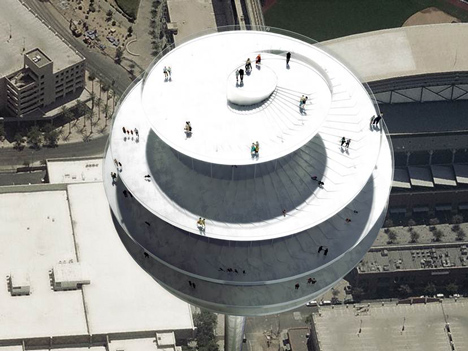
Just like the Guggenheim Museum in New York and the ArcelorMittal Orbit at London's Olympic Park, visitors will be encouraged to take an elevator to the top then gradually work their way down whilst looking out across the city and nearby mountains.
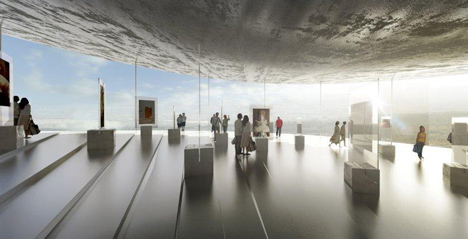
"Like the monsoons, the haboobs and the mountains of the surrounding Arizonian landscape, the Pin becomes a point of reference and a mechanism to set the landscape in motion through the movement of the spectator," commented BIG founder Bjarke Ingels. "The motion at the Pin is turned inside-out, allowing visitors to contemplate the surrounding city and landscape of Phoenix."
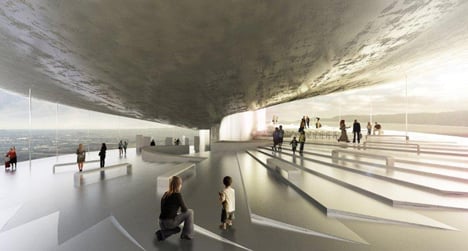
To create the spherical shape, the spiralling open-air pathway will be widest at its centre and will taper away at the start and end of the route.

"Like a heavenly body hovering above the city the Pin will allow visitors to descend from pole to pole in a dynamic three dimensional experience seemingly suspended in midair," said Ingels.

Restaurants will be located at the base of the sphere, while a new public square surrounded by shops will be positioned at the ground-level entrance.
In the last week BIG also unveiled plans for two twisted apartment blocks in Miami.

See all our stories about BIG »
Here's some more information from the architects:
BIG unveils Phoenix Observation Tower
BIG is commissioned by Novawest to design a 420 ft tall mixed-use observation tower to serve as a symbol for the city of Phoenix, Arizona.
Located in downtown Phoenix, the 70,000 sf Observation Tower shall add a significant structure to the Phoenix skyline from which to enjoy the city's spectacular views of the surrounding mountain ranges and dramatic sunsets. Phoenix-based developer Novawest, commissioned the team to create a destination event to provide tourists and citizens of Phoenix alike the chance to enjoy the unique features of the Valley of the Sun.
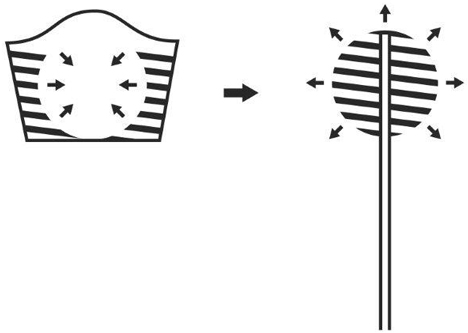
Above: simple concept diagram
The future observation tower is conceived as a tall core of reinforced concrete with an open-air spiral sphere at its top, resembling a metaphorical pin firmly marking a location on a map. The spiraling sphere contains flexible exhibition, retail and recreational spaces which are accessed via three glass elevators that connect the base with the summit and offer panoramic views of the city and the tower's programs as visitors ascend or descend.
Walking downwards from the top through a continuous spiral promenade, the visitors of the observation tower experience all of the building's programs in a constant motion, while enjoying dynamic 360 degree views of the city of Phoenix and the Arizonian landscape.
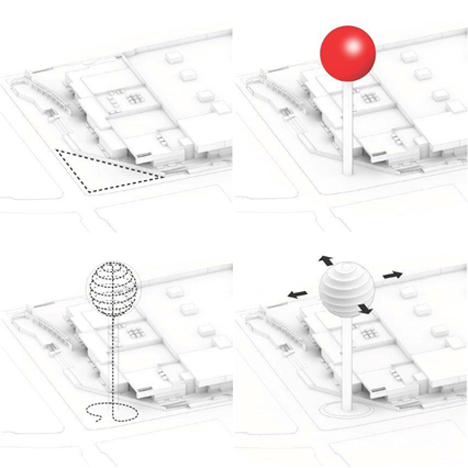
Above: design concept
The spiral layout combines the different programmatic elements and the circulation into a continuous dynamic twirling space which is proportioned according to the movement of the visitors, producing a unique viewing experience of the surroundings. Instead of a constant width, the spiraling promenade starts from zero at the point of arrival, reaches its maximum width at the middle, and shrinks back to zero at the point of departure. Separation between the programmatic elements within the sphere happens not through physical vertical barrier-walls, but softly through the slope and the height difference to preserve a total continuity and create a flexible space for exhibitions and events.
Once the visitors reach the middle of the sphere, they can choose to either conclude their journey by taking the elevator back to the ground, or continue to the restaurant levels at the lower hemisphere. The motion resembles a journey through the center of a planet, and a travel from the north to the south pole.
The base of the tower will serve as a public plaza offering shade, water features and a small amount of retail together with a subterranean queuing area. The tower will serve as a working model of sustainable energy practices, incorporating a blend of solar and other technologies.
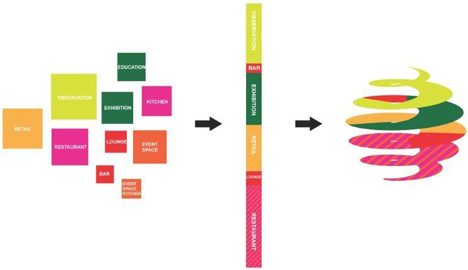
Above: accommodation diagram
Name: Phoenix Observation Tower
Type: Commission
Size: 70,000 square feet
Client: Novawest
Collaborators: MKA (structure), Atelier10 (sustainability), Gensler (local architect), TenEyck (landscape)
Location: Phoenix, Arizona
Country: USA
Partner in Charge: Bjarke Ingels and Thomas Christoffersen
Project Leader: Iannis Kandyliaris
Team: Thomas Fagan, Aaron Hales, Ola Hariri, Dennis Harvey, Beat Schenk