“We’re not saying they’re perfect” says architect fighting to save Melbourne’s public housing blocks

Photography by Ben Hosking, Michael Pham
Architect Simon Robinson has been leading calls for the Victorian state government to rethink its plan to demolish all of Melbourne’s public housing towers. In this interview, he sets out why he believes retrofit is the smarter approach.
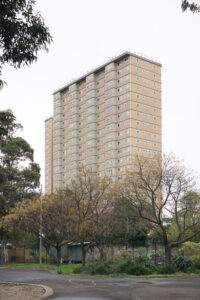
Announced by the Labor-run state government in 2023, Homes Victoria’s High-Rise Redevelopment Program (HRRP) will see all 44 of Melbourne’s public housing towers and many other lower-rise blocks razed and replaced with new housing by 2051.
Officials argue that the buildings, constructed between 1962 and 1975, have reached the end of their useful lives. They claim the towers do not meet modern standards and cost too much to maintain, and that the redevelopment programme will triple housing capacity and improve the quality of homes.
But the policy has proved highly controversial, with critics particularly angry about a lack of transparency or consultation with residents, who are being relocated.
It is now subject to an ongoing legal dispute, has prompted concern from the UN’s special rapporteur on housing, and become a political issue in the build-up to the Victorian state election later this month.
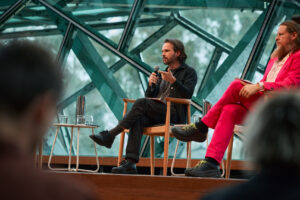
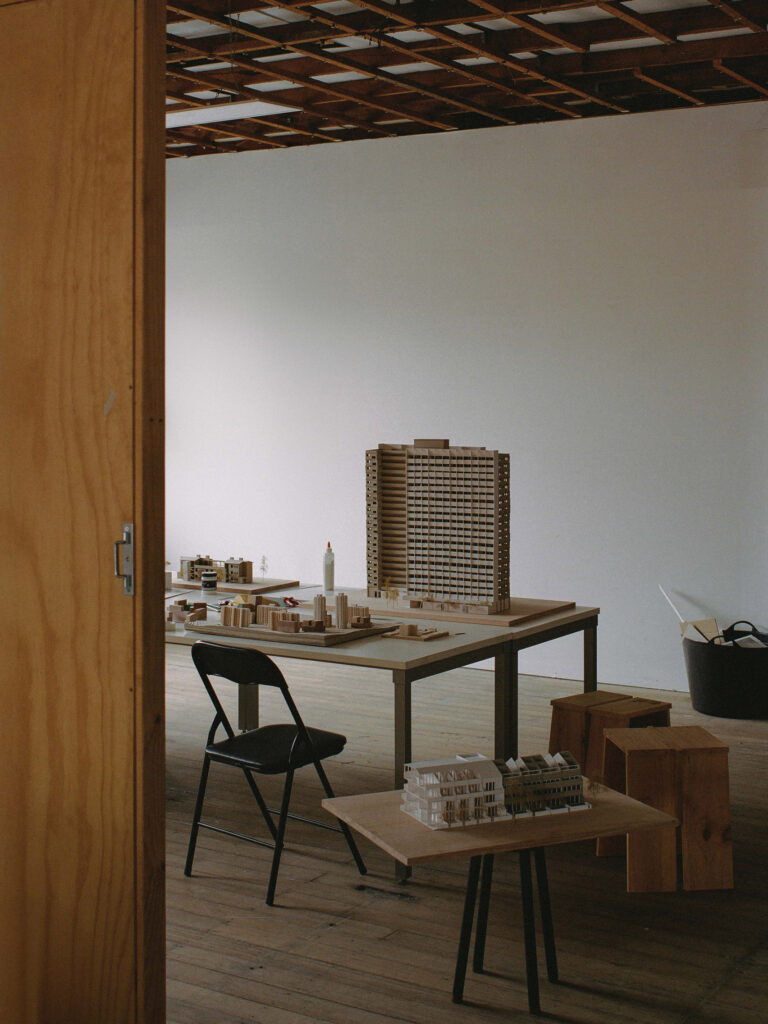
Among the voices leading calls for a change of course is Melbourne not-for-profit research and design practice Office.
Office has worked pro bono to make the case for refurbishing the towers, after learning from residents that the government has not published feasibility studies for keeping any of the condemned estates.
“We thought that was pretty odd that you wouldn’t do a refurbishment study on these estates,” Office director Simon Robinson told Dezeen.
“So we took it upon ourselves to start to do these feasibility studies, along with public housing residents.”
“We’re not saying that they’re in perfect condition,” he added. “We’re also not saying that all of them should be refurbished – perhaps some are beyond repair. All we are saying is that these rapprochement studies need to occur.”
Cost of relocating residents “very significant”
In fact, feasibility studies have been conducted by the government but not been made public, despite requests by the Victorian Legislative Council.
By avoiding the relocation of residents, Office estimates that a retrofit and infill approach would cost around $300 million less than demolition and rebuild.
“As all the estates are occupied, the cost of relocating and housing the residents during construction work needs to be included in the project cost; this is consistently excluded and never disclosed,” said Robinson.
“We have estimated that these costs are very significant, with reports indicating that the government is spot purchasing or head-leasing properties from the private market.”
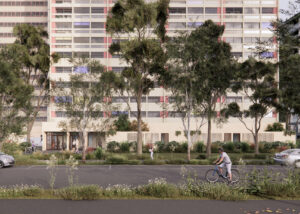
The practice has put together a counter-proposal based on a strategy that it calls Retain Repair Reinvest (RRR).
RRR focuses on retaining buildings without displacing residents, carrying out renovation work to improve housing comfort and energy efficiency while reducing construction waste and carbon impact.
Robinson agrees that most of Victoria’s existing public housing buildings are currently not fit for purpose – buildings are rundown, cold in winter, and sweltering in summer. But he believes comfortable living standards can be achieved through renovations.
Office has applied its RRR strategy to three Melbourne estates in hypothetical case studies – Ascot Vale Estate, Barak Beacon Estate and the Flemington Estate.
“There’s no public housing being rebuilt”
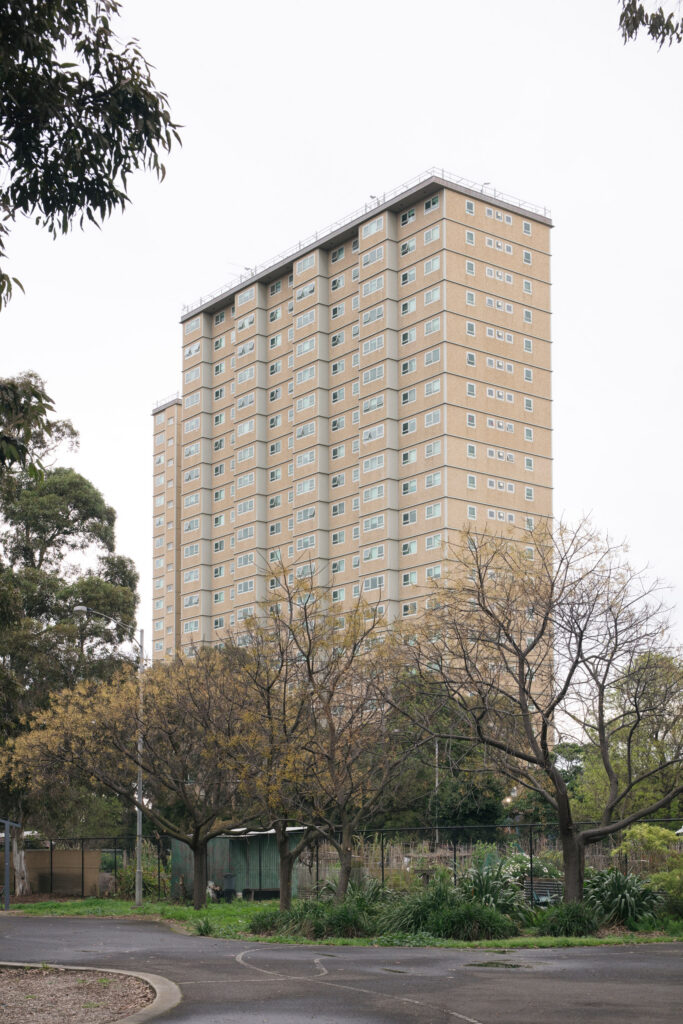
Formerly home to approximately 10,000 people, Flemington Estate’s four towers make up about 10 per cent of Victoria’s public housing stock.
Only about 32 households remain, though an injunction prevents Homes Victoria from serving further eviction notices while legal challenges are pending.
Office has proposed retaining the estate’s 720 dwellings and building an additional 577 infill social housing units to increase density.
New facades and private balconies would be added, with other upgrades including integrated underground parking, a central communal green space, new heating and cooling systems, improved insulation, new kitchens and bathrooms.
Energy efficiency is another key focus. Double-glazed windows, photovoltaic cells, and water conservation systems would provide a 55 percent reduction of global warming potential compared to the demolition approach, according to Office.

Despite the seemingly obvious benefits, the Victorian government has so far been unmoved by the studies presented by the practice.
Robinson believes the reason lies in the fact that the state government no longer wants to manage public housing.
“When the state government manages public housing, they are responsible for maintaining the buildings and organising new tenants – all the admin that comes with owning a building,” he said.
As well as the demolitions, also attracting concern is the type of housing proposed for redevelopment under the HRRP.
Rather than like-for-like public housing, the new homes will be “community housing” – developed by private developers, and split between below-market and market-rate rental homes.
Despite still being classed as social housing by the state government, community housing is slightly more expensive, and the tenancy is less secure from eviction.
Robinson believes the term was created to misdirect the public.
“What they’re building is community housing, not public housing, so there’s no longer any public housing being rebuilt in Victoria,” he said.
“The government is now calling everything social housing, because they don’t want the public to know that it’s no longer public housing,” he continued.
“Victoria has the lowest percentage of public housing stock in Australia, and we’re currently demolishing it all and turning it into private and community housing.”
“Public housing is foundational social infrastructure”
The issue is particularly charged in the context of Australia‘s housing-affordability crisis. There are currently over 60,000 people on the waitlist for social housing in Victoria, where social housing accounts for three per cent of all dwellings, below the national average of 4.2 per cent and the OECD average of 7 per cent.
“Public housing serves as foundational social infrastructure that treats shelter as an essential human right,” said Robinson.
“By offering rents permanently capped to income and delivering unmatched security of tenure, it provides an unconditional safety net for society’s most vulnerable households.”
Office’s work has gained political attention. In November 2023, the Victorian Legislative Council debated the merits of the RRR approach, with the council’s Legal and Social Issues Committee urging the government to reconsider demolition and explore all refurbishment options.
The team can already claim a small victory. At Ascot Valley Estate, the first RRR case study released by Office, the development was quietly removed from the planned demolitions list on the Homes Victoria website and part of the estate has since been refurbished.
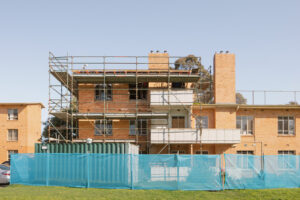
The estate is a collection of 57 three-storey brick housing blocks, built in 1947 and designed by renowned modernist architect and public housing advocate Best Overend during his time with the Housing Commission.
This gave Robinson and his team hope that the government would consider the alternatives if presented with the option.
“We have presented to Homes Victoria, we’ve presented to different ministers as well, and we’ve kind of heard that they are starting to look at retrofit some of their existing building stock,” said Robinson.
“It kind of suggests that perhaps they’re gonna prefer we show all of them. So we released the following studies on Barak Beacon Estate and the Flemington Estate.”
However, Barak Beacon Estate has since been demolished, and the construction of the redevelopment is due to complete by the end of the year.
Now the fate of Flemington Tower awaits a ruling from the High Court of Australia following a hearing last month.
A class action filed by Inner Melbourne Community Legal on behalf of public housing residents in North Melbourne and Flemington is on its last appeal, after the Supreme Court of Victoria and Victorian Court of Appeal ruled in favour of demolition.
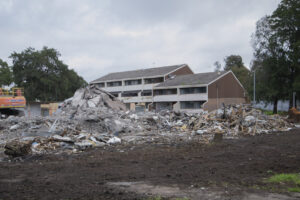
Meanwhile, the Liberal opposition has pledged to pause the HRRP if it wins office at the upcoming state election.
Robinson hopes he and his team have done enough, and continue to raise awareness about the issue.
“We’ve gotten to a point where we feel we can’t just keep putting out these reports,” he said.
“The papers we produced are quite dense and not for the general public. So what we’re now doing is translating that work into a series of publications, putting it in bookshops, and making it more accessible for the general public.”
“We continue interviews with different residents, different advocates, different professionals, speaking with journalists and doing lectures. The idea is to bring awareness to what’s occurring, rather than us doing more reports.”
He is also calling for a frank discussion in the architecture community about the redevelopment projects, which many of Australia’s prominent studios are working on.
“All the big-name architects are working on these estate renewals, some have even won awards as exemplar projects for these architects to promote their practice in terms of doing public good,” said Robinson.
“It’s really hard to find anyone who’s willing to talk about why they’re doing it, or is it good, the displacement and environmental issues. We’re alone.”
Dezeen put Robinson’s claims to the Victorian state government, but was told it could not respond in the lead-up to the election.
Dezeen In Depth
If you enjoy reading Dezeen’s interviews, opinions and features, subscribe to Dezeen In Depth. Sent on the last Friday of each month, this newsletter provides a single place to read about the design and architecture stories behind the headlines.
Photography by Ben Hosking, Michael Pham
Read more
Recommended stories
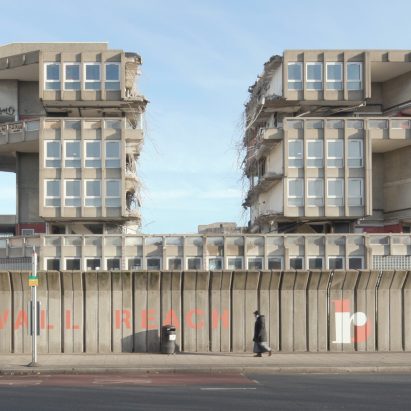
Demolition of council estates “has peaked”
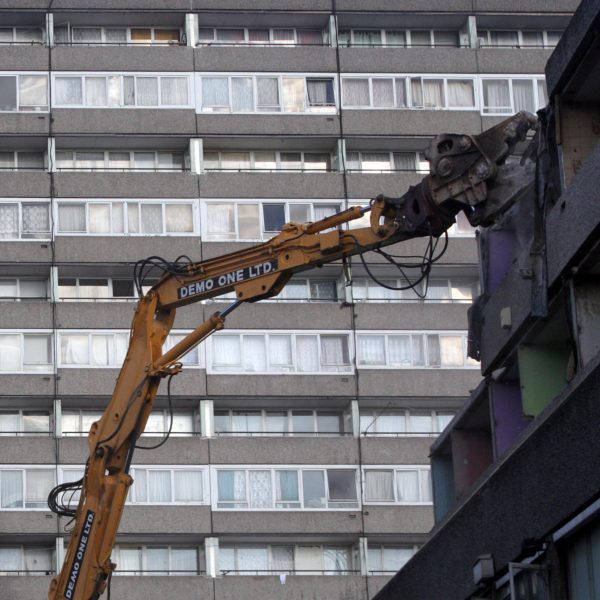
“The tide may finally be turning against knocking down social-housing estates”
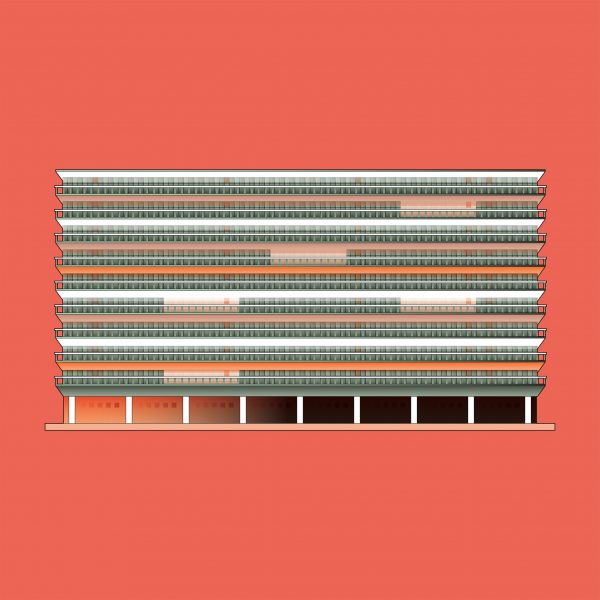
Lacaton & Vassal, Frédéric Druot and Christophe Hutin’s Transformation of 530 Dwellings was the most significant building of 2016
Breathe challenges Australia’s large homes in Home Truth pavilion at NGV
Finding Infinity develops $100 billion zero-carbon strategy for Melbourne “that would pay for itself in less than 10 years”
“We need a major shift in the way we look at public housing”
Austin Maynard Architects develops “ethical housing” in inner-city Melbourne