Daniel Bjorkman creates logo generator for Akademin Valand art school
Interaction designer Daniel Bjorkman has created a conceptual adaptive logo and visual identity for Swedish art school Akademin Valand (+ slideshow).
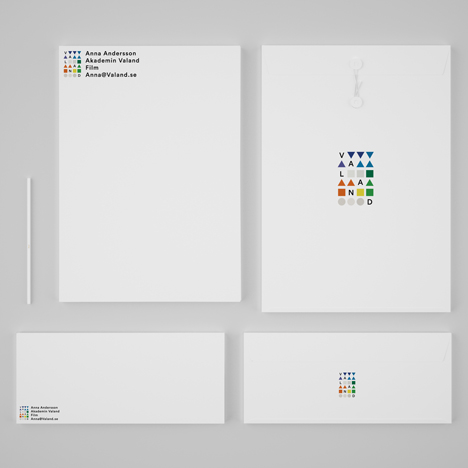
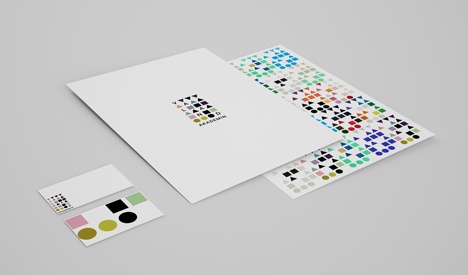
The logo spells out Valand in stacked letterforms, which form part of a rectangular grid of circle, triangle and square shapes in various colours.
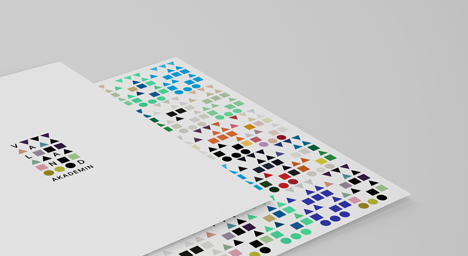
The colours of the logo can be modified using an online tool, which would allow teachers and students at the university to upload a portrait or picture of their choosing.
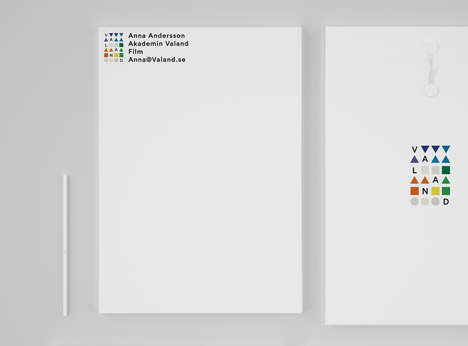
The logo generator creates a new graphic symbol using the underlying structure of the logo, but with colours from the uploaded image. Individuals can then download their personal symbol for use on printed or digital materials.
“I think an art school should be about a time for experimentation, and everyone who attends will have such a different expression,” Bjorkman told Dezeen. “It would be nice if that could shine through in how the school presents itself.”

The multiple possible outcomes of the logo are reflective of the Gothenburg school itself, which teaches a wide range of disciplines including art, photography and film.
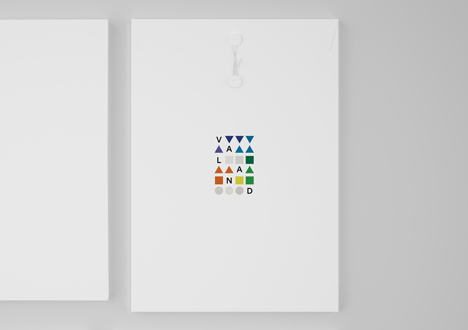
“I settled on simple geometric shapes that correspond to each letter on every row, but in a simpler way, and put them in a pattern that could be used just by itself or combined together to create larger patterns,” Bjorkman said. “Then it was a matter of taking that vision and putting it into code and making it generative.”
New York design agency Sagmeister & Walsh has created a similarly adaptive identity for cloud software management brand Fugue – although in this instance the logo changed according to touch and sound input.
“Design will definitely be more adaptable and governed by code in the future at least,” Bjorkman added. “As we develop cheaper screen and digital paper designers will have to understand what can be done and utilise the possibilities and restraints of these new mediums. I think a lot of the interesting things that can be done will be by programmatic/generative design.”
Read more
Recommended stories
ArkDes exhibition explores Stockholm Design Lab’s everyday graphic design

Sagmeister & Walsh creates a logo for Fugue that moves to music
Front uses AI to translate sketches into “brilliantly bad” objects

Creuna Norway creates simplified visual identity for the city of Oslo
Manual creates branding for Eames Institute of Infinite Curiosity with “dynamic configurations”

Ericsson’s “three sausages” logo refined for digital users

Open-source visual identity for Eindhoven by Virtual Design Agency