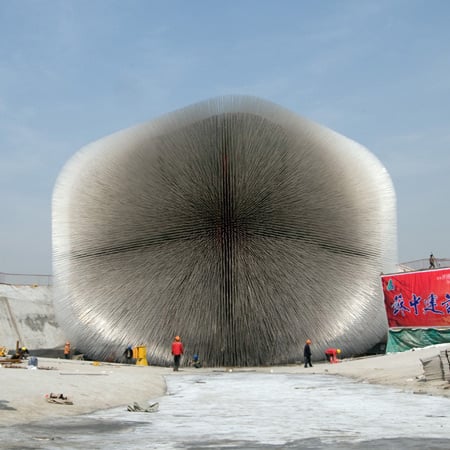
UK Pavilion at Shanghai Expo 2010 by Thomas Heatherwick
Shanghai Expo 2010: Thomas Heatherwick's UK Pavilion is nearing completion for the Shanghai Expo 2010, which opens in May.
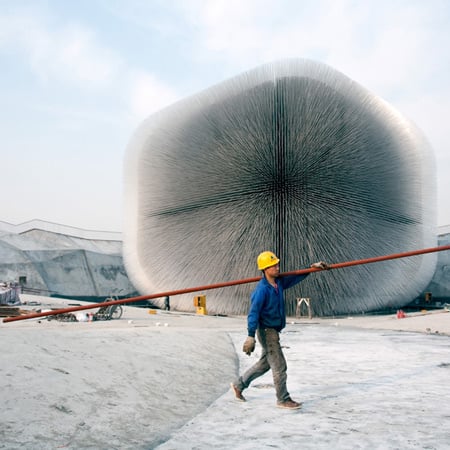
Called Seed Cathedral, the wooden structure is pierced by 60,000 fibre-optic rods that each contain plant seeds at their tips.
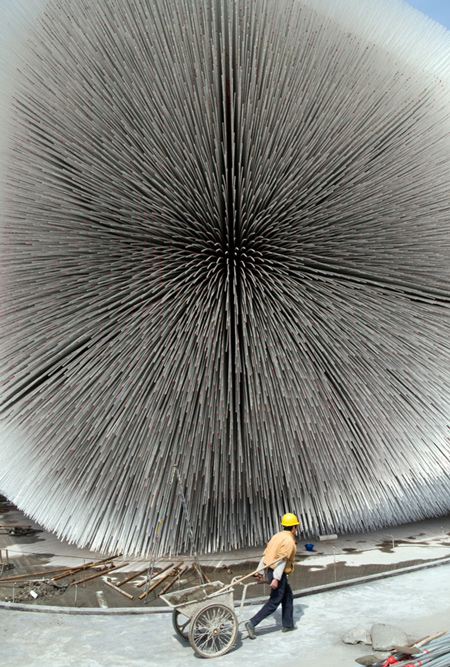
These rods will draw light into the pavilion during the day and direct it outwards at night.
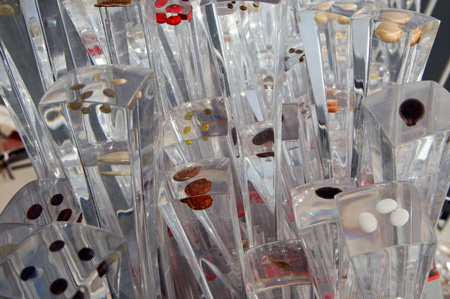
After the expo the rods and seeds will be distributed to schools in China and the UK.
The Shanghai Expo will take place 1 May to 31 October 2010.
More information in our earlier stories here and here.
The following information is from Thomas Heatherwick:
THE DESIGN OF THE UK PAVILION
AT THE 2010 SHANGHAI EXPO
The UK Pavilion at the 2010 Shanghai Expo expresses British creativity and environmental engagement at the biggest event of its kind since the Expo phenomenon began in 1851 with the Great Exhibition at London's Crystal Palace. Since then, there have been more than 50 Expos – which have also been known as World’s Fairs or World Expositions – and the most spectacular have included those at Chicago in 1893 and Paris in 1900. The latter attracted 50m visitors, a record at the time, setting an early benchmark for a country’s portrayal of innovation and progress.
Held under the auspices of the Bureau International des Expositions, the Shanghai Expo will be the largest the world has ever seen. Staged on a 5.28km2 city centre site beside the Huangpu River, it features pavilions representing the ideas and cultural and commercial ambitions of more than 200 countries and international organisations. Visitor numbers are expected to reach a record 70m during the six month event, which runs from May 1 to October 31.
The UK Pavilion has been designed by Heatherwick Studio. Led by the internationally-acclaimed Thomas Heatherwick, his design team won the Foreign & Commonwealth Office (FCO) commission to create the Pavilion following a competition that attracted a shortlist of ambitious architectural proposals from other teams led by Zaha Hadid Architects, John McAslan + Partners, Marks Barfield Architects, Avery Associates, and DRAW Architects with dcmstudios.
Heatherwick Studio’s initial design strategy for the UK Pavilion established three aims to meet the FCO’s key expectation that the pavilion should become one of the five most popular attractions at the Expo. The first aim was to design a pavilion whose architecture was a direct manifestation of what it was exhibiting. The second idea was to ensure a significant area of open public space around it so visitors could relax and choose either to enter the pavilion building, or see it clearly from a calm, non-queuing vantage point. And thirdly, it would be unique among the hundreds of other competing pavilions, events and programmes.
Heatherwick Studio sought an approach that would engage meaningfully with Shanghai Expo’s theme, Better City, Better Life, and stand out from the anticipated trend for technology driven pavilions, filled with audio-visual content on screens, projections and speakers.
In collaboration with a wider project team, the studio developed the idea of the UK Pavilion exploring the relationship between nature and cities. Rather than creating a conventional advertisement for the UK, this was a subject that could make a real contribution to the Expo’s theme; London is the greenest city of its size in the world, the UK pioneered the world’s first ever public park and the world’s first major botanical institution, the Royal Botanic Gardens at Kew.
From here came Heatherwick’s idea of involving Kew Gardens’ Millennium Seedbank whose mission is to collect the seeds of 25% of the world’s plant species by 2020.
The design process evolved to produce two interlinked and experiential elements: an architecturally iconic Seed Cathedral, and a multi-layered landscape treatment of the 6,000m2 site.
The Seed Cathedral sits in the centre of the UK Pavilion’s site, 20 metres in height, formed from 60,000 slender transparent fibre optic rods, each 7.5 metres long and each encasing one or more seeds at its tip. During the day, they draw daylight inwards to illuminate the interior. At night, light sources inside each rod allow the whole structure to glow. As the wind moves past, the building and its optic “hairs” gently move to create a dynamic effect.
Heatherwick previously experimented with texture and architecture at a much smaller scale with his Sitooterie projects. The Seed Cathedral is the ultimate development of this.
Inside the darkened inner sanctum of the Seed Cathedral, the tips of the fibre optic filaments form an apparently hovering galaxy of slim vitrines containing a vast array of embedded seeds. The seeds have been sourced from China's Kunming Institute of Botany, a partner in Kew Royal Botanic Gardens’ Millennium Seed Bank Project. Visitors will pass through this tranquil, contemplative space, surrounded by the tens of thousands of points of light illuminating the seeds.
These fibre optic filaments are particularly responsive to external light conditions so that the unseen movement of clouds above the Seed Cathedral are experienced internally as a fluctuating luminosity. The studio's intention is to create an atmosphere of reverence around this formidable collection of the world’s botanical resources; a moment of personal introspection in a powerful silent space.
The Seed Cathedral is made from a steel and timber composite structure pierced by 60,000 fibre optic filaments, 20mm square in section, which pass through aluminium sleeves. The holes in the 1 metre thick wood diaphragm structure forming the visitor space inside the Seed Cathedral were drilled with great geometric accuracy to ensure precise placement of the aluminium sleeves through which the optic fibre filaments are inserted. This was achieved using 3D computer modelling data, fed into a computer controlled milling machine.
This accuracy ensures that the Seed Cathedral’s fibre optic array creates an apparent halo around the high structure, with the fibre optic filaments rippling and changing texture and reflectivity in the gentlest wind. The wavering external surfaces of the Seed Cathedral form a delicate connection between the ground and the sky.
Among the Expo’s sea of hard surfaces, the Seed Cathedral’s surrounding landscape is conceived to act as a continuation of the building’s texture. A special artificial grass surface has been uniquely developed to act as a welcoming and restful public space for Expo visitors. Beneath the Seed Cathedral and the landscaped surface area is a canopied and naturally ventilated entrance and exit sequence for the Seed Cathedral. This circulation zone, running along three edges of the site, contains a narrative of three innovative environmental installations designed by London-based design studio, Troika. They are: Green City, Open City, and Living City.
Below the circulation zone is a further layer of spaces which can be used for cultural and commercial events hosted by the Foreign and Commonwealth Office and is available to hire by other organisations throughout the duration of the Expo.
The creation of the extraordinary and complex Seed Cathedral structure and the landscape architecture was achieved through close collaboration between construction managers Mace, lead engineers Adams Kara Taylor, services engineers Atelier Ten and highly skilled Chinese engineers and contractors. In order to reduce unnecessary transportation, 75% of the materials for the UK Pavilion have been sourced from within a radius of 300km around Shanghai. It is also the British government’s intention that most of the materials of the UK Pavilion will be reused or recycled at the end of the Expo.
The UK Foreign & Commonwealth Office believe that the Seed Cathedral and UK Pavilion site will prove to be one of the Shanghai Expo’s star attractions. Even before the start of the Shanghai Expo, that belief already has some substance; ever since Heatherwick Studio’s design was first publicised in Shanghai in 2009, along with the scores of other national pavilion designs, it has been consistently ranked in the top five in terms of public popularity, and the Seed Cathedral has already been nick-named Pu Gong Ying, translated as 'The Dandelion' by the Chinese public.
After the Expo just as dandelion seeds are blown away and disperse on the breeze, the Seed Cathedral’s 60,000 optic hairs, each one containing the huge potential of life, will be distributed across China and the UK to hundreds of schools as a special legacy of the UK Pavilion at the 2010 Shanghai Expo.
For job opportunities at Heatherwick Studio, visit their company profile on Dezeen Jobs.
Location: Shanghai, China
Public Opening: 1st May 2010
Site area: 6000m2
Seed Cathedral dimensions:25m x 25m x 20m
Seed Cathedral floor area: 105m2
Optic fibres: 60,588
Optic fibres length: 7.5m
Seeds in Seed Cathedral: 217,300
Landscape area: 4490 m2
Public park area: 2405 m2
Accommodation area: 1525 m2
Exhibition area: 1280 m2
Lead Designer: Heatherwick Studio Project team: Thomas Heatherwick, Katerina Dionysopoulou, Robert Wilson, Peter Ayres, Stuart Wood, Ingrid Hu, Jaroslav Hulin, Chiara Ferrari and Ramona Becker
Main Client: Foreign & Commonwealth Office
Project Manager: Mace Group
Structural Engineer: Adams Kara Taylor
Environmental Engineer: Atelier Ten
Fire & Risk engineering: Safe Consulting
Executive Architect: Architectural Design & Research Institute of Tongji University
Supporting Architects: RHWL
Quantity Surveyor: Davis Langdon & Seah
Walkway Exhibition Design: Troika
Content Advisory Team: Mark Jones, John Sorrell, David Adjaye
Content Advisor: Philip Dodd
Content Coordinator: Adriana Paice
Funding - Sponsors - Public Sector: Foreign & Commonwealth Office UK Trade & Investment British Council Department for Communities and Local Government Department for Environment,
Food and Rural Affairs Department for Business, Innovation and Skills, England’s Regional Development Agencies,
Sponsors – Private Sector: AstraZeneca, Barclays, BP, Diageo, GKN