How Gaudí's Crypt paved the way for parametricism
Next up in our Gaudí Centenary series, we tell the story of the Church of Colònia Güell, for which Antoni Gaudí's renowned hanging models were first developed, marking the beginnings of parametric design.
With mirrors on the floor and clusters of weighted strings suspended from the ceiling, entering Gaudí's workshop in 1898 would likely have felt like stepping into the mind of a mad scientist.
Yet for Gaudí, these complex webs were not eccentric experiments. They were the ingenious form-finding models adding much-needed clarity to his ambitious vision for the Church of Colònia Güell.
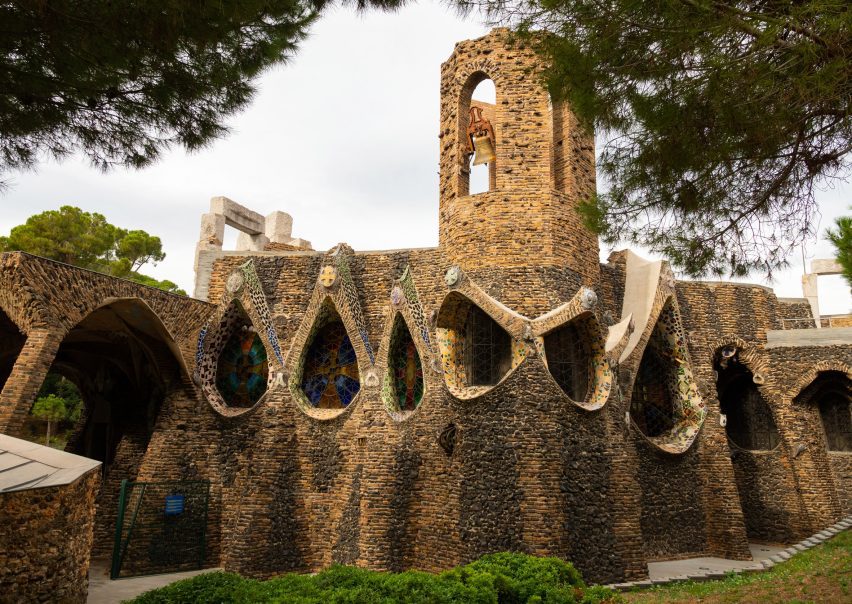
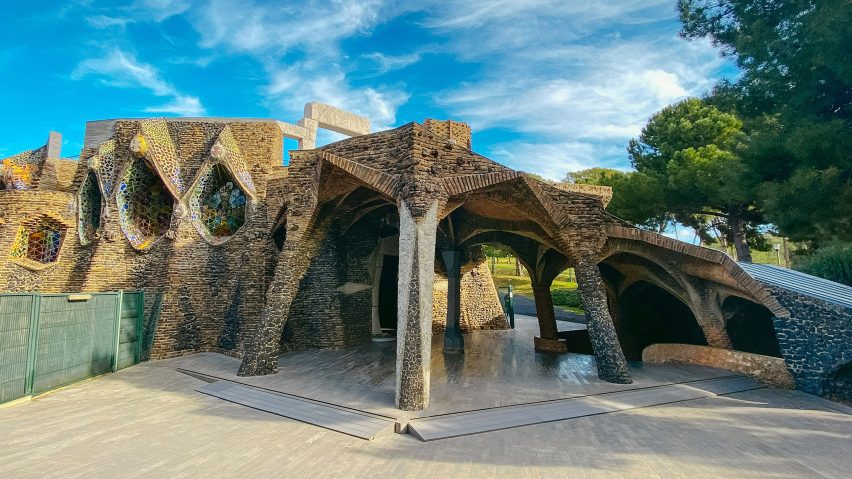
Also known as Gaudí's Crypt, the church project on the outskirts of Barcelona is recognised today as one of the architect's most important works, despite never actually being completed.
It is significant because it was the first project for which Gaudí developed his hanging-chain funicular models – an early, physical form of parametric design – and served as a testbed for the Sagrada Familia.
In the words of Gaudí himself, if it had been completed, it would have been "a monumental model" of the world-famous basilica.
Gaudí's models were experiments in funicular geometry
Gaudí was commissioned for the Church of Colònia Güell in 1898 by his long-term patron, the Spanish industrialist Eusebi Güell. It was planned as a place of worship for workers at Guell's textile factory in Santa Coloma de Cervelló, near Barcelona.
The then 46-year-old Gaudí was granted total freedom on the design, sparking his decision to test his pioneering structural innovations for the first time.
Specifically, he used it as an opportunity to experiment with funicular geometry, such as catenary curves, as well as hyperbolic paraboloids and hyperboloids.
Hyperbolic paraboloids are saddle-shaped surfaces, while hyperboloids are curved vaults that can be made from straight lines. Using them allowed Gaudí to create large, open spaces without the need for buttresses or supporting walls – as seen in the crypt.
View this post on Instagram
Gaudí designed the church using a hanging model
To test and calculate these forms, Gaudí developed a gravity-assisted hanging model formed of ropes and chains, which were attached to lead-filled sacks to form U-shaped curves.
Mirrors beneath the chains then allowed him to view the model upside down, visualising those same curves, hanging in tension, as buildable arches, vaults, and columns under compression.
Similar to parametric design software used by architects today, the hanging model also worked so that if one parameter was altered – such as the length of the string – the entire model would rebalance into an optimised catenary geometry.
As such, the models are often cited as an analogue precursor to parametric design and, therefore, parametricism – a 21st-century style of architecture that results from using digital design tools – long before the digitisation of architecture.
New Zealand academic Mark Burry, who is among the fifth generation of workers on the Sagrada Familia, said this revolutionary vision was likely sparked by Gaudí's geometry lessons at architecture school.
"He zeroed in on geometry, which he would have learned about at school, because a sixth of an architect's education in those days was descriptive geometry," Burry told Dezeen.
"He's probably the only person who ever saw the hyperboloid in the book that he studied from," he continued. "He's the only person who saw it and recognised the potential for it."
"He found a way to get kind of voluptuous, sensually warped surfaces that had a very simple logic."
Gaudí's design symbolised journey to salvation
After 10 years of designing, the construction of the church began. However, in 1915, after Güell died, his family decided to cease building works.
Though it was never realised in full, Gaudí's final design for the Colonia Guell church was intended to be a symbolic journey through darkness and into the light of salvation.
It would have had both a higher and lower nave, or main hall, enclosed by side towers and a 40-metre-tall cupola. The lower nave, now known as the crypt, was the only part to be completed.
The crypt marked the start of the journey in darkness, built from clinker bricks, basalt stones and iron slag with dim, earthy tones and a rugged, textured appearance.
The upper nave was expected to have been completed with gold, blue, and white tones, representing the light, alongside towers topped with white doves.
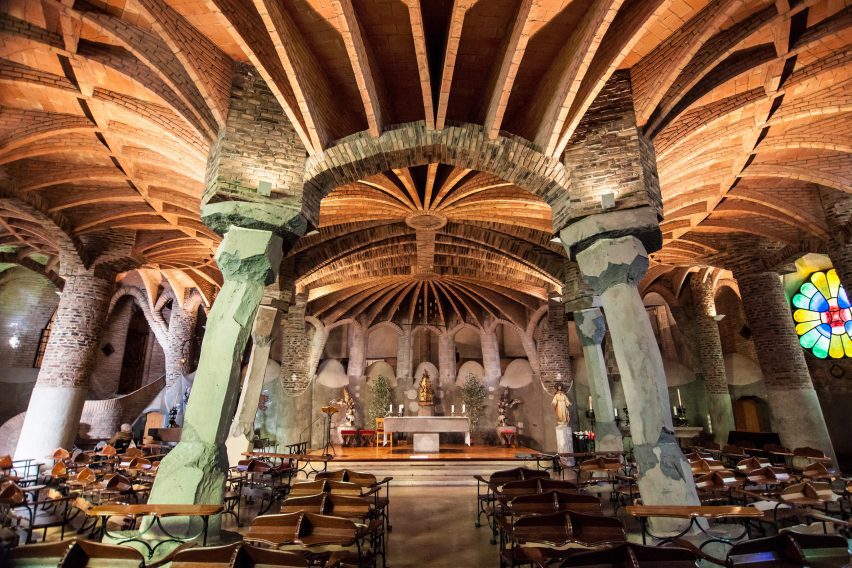
Today, visitors to the crypt can see Gaudí's structural innovations in its slanted and twisted columns, inspired by tree trunks and branches, and vaulted roofs and walls, which give rise to a large open space with an uninterrupted view of the altar.
Its four central columns made from basalt would have supported the full load of the church above, but today they just support the crypt's roof, which is formed of two hundred brick ribs.
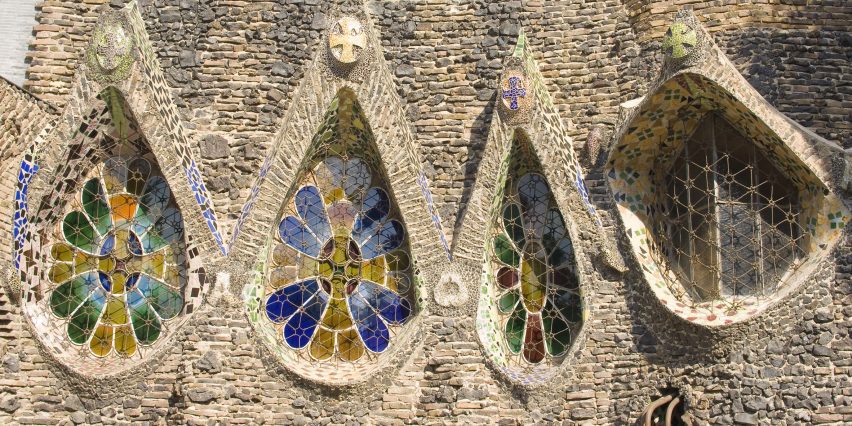
Outside, the crypt is framed by a series of stained-glass windows shaped like butterflies and surrounded by intricate stonework and mosaics in different colours and textures, with Greek symbols repeated between.
Gaudí's Crypt could have been his "best building"
The only way to see what the finished church could have looked like now is in detailed reconstructions of Gaudí's hanging model, such as the one at the Colònia Güell Interpretive Centre.
Though, for many, the crypt itself is a masterpiece in its own right, often referred to as the architect's most original work. In 1990, this led it to be protected with Cultural-Historical Interest status, before being listed as a World Heritage Site by UNESCO in 2005.
In an interview with Dezeen, Gaudí biographer Peter Stanford described the church as "both Neanderthal and a spaceship at the same time", while academic Burry believes that it would have eclipsed the world-famous basilica in its reputation, had it been finished.
"I think that the Church of Colònia Güell would have been Gaudí's best building," Burry told Dezeen.
"If he'd been allowed to complete it, it wouldn't have needed any modern computation. He was using the most modest of materials, and the shape was already computed by his hanging model," Burry continued.
"I go at least once a year to the Church of Colònia Güell, because it gives me goosebumps when I go in."
The photography is courtesy of Adobe Stock unless otherwise stated.
Gaudí Centenary
This article is part of Gaudí Centenary, our editorial series profiling the Catalan architect and designer Antoni Gaudí, marking 100 years since his death.