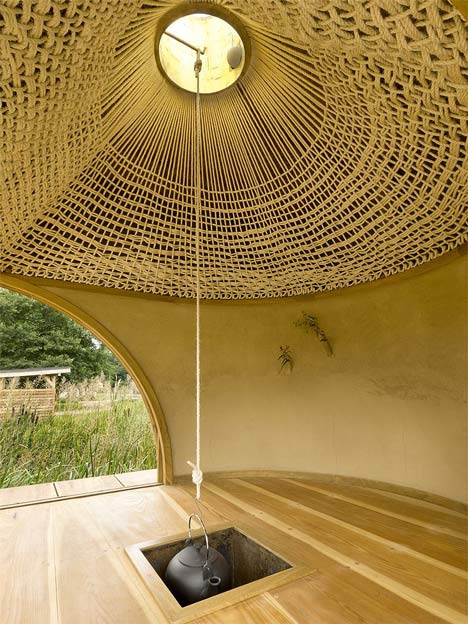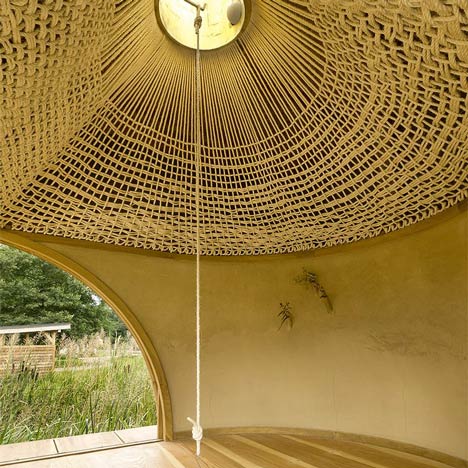
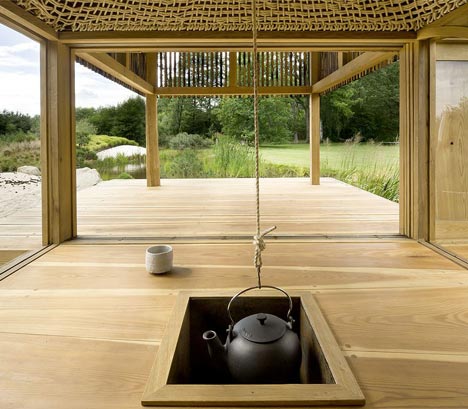
Visitors to this timber tea house sit beneath a woven rope dome with a gilded skylight and a hanging teapot in the middle.
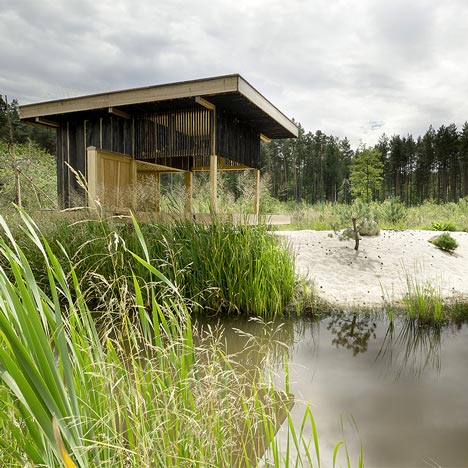
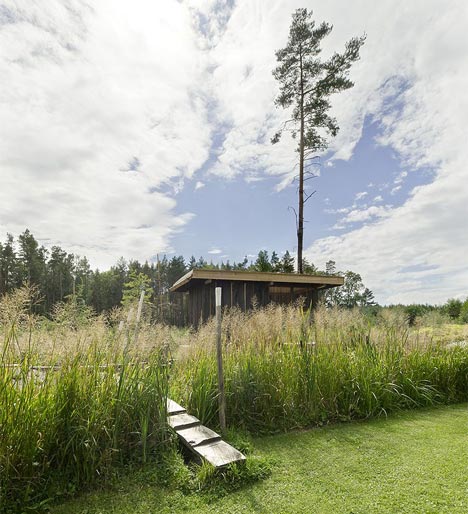
The building, named Black Teahouse, was designed by Czech studio A1Architects and sits beside a lake and woodland near the city of Česká Lípa.
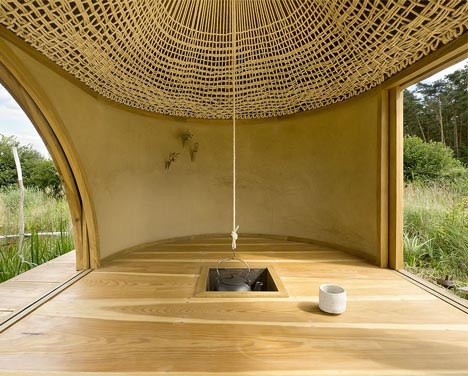
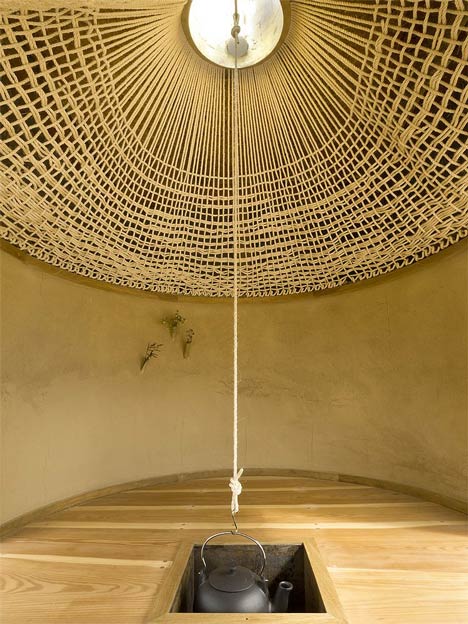
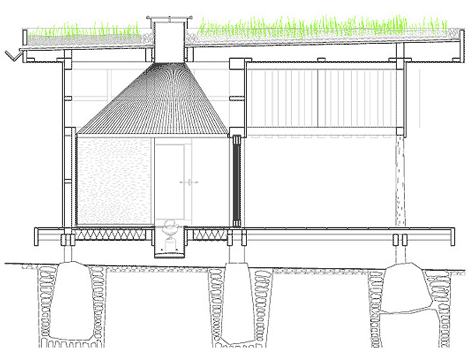
The teapot is suspended from the ceiling by a knotted length of rope and nestles into a crevice in the floor.
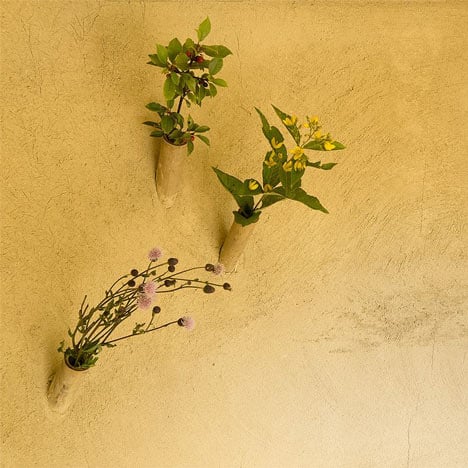
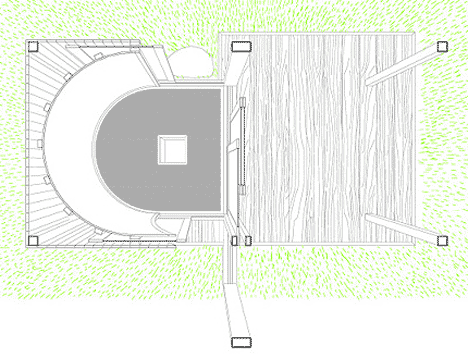
The round walls of the building are coated in clay plaster and integrate three flower vases.
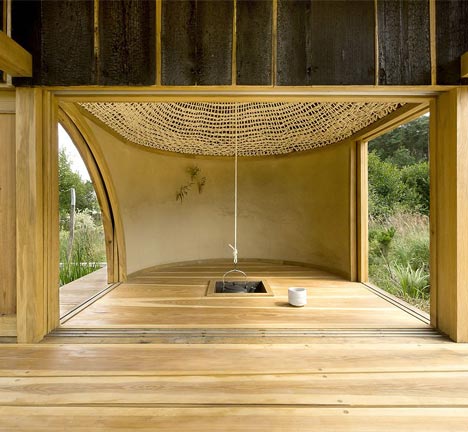
Large doors slide back from both rectangular and arched openings in the walls of the tea house to open it out to a sheltered deck.
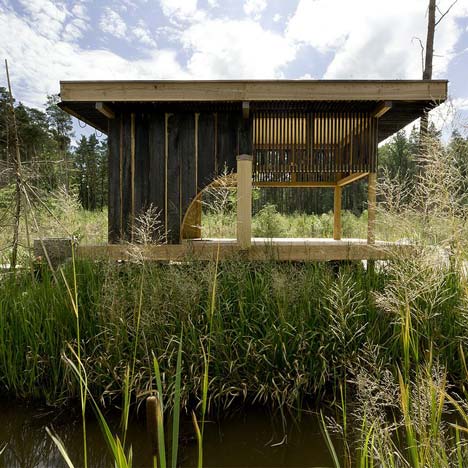
The exterior of the larch building has been charred.

A1Architects also recently completed an apartment where a stainless steel net takes the place of a banister - see our earlier story here and see all our stories about A1Architects here.

Another tea house featured on Dezeen in the last month is a music room that hangs like a lantern – click here to see all our stories about tea houses.
Here’s some more text from A1Architects:
Black Teahouse
Place
On the southern edge of garden The Black Teahouse reflects itself in water level of small dark lake.

Large and exceptionally cultivated garden becomes natural part of nearby pine forest and its southern edge defined by S-shaped lake with grassy banks makes beautiful surroundings of the family house. And the Teahouse is just part of this carefully designed scenery.

There is fabulous view of the lake, which could be admired by the host and guests from the teahouse. It is a small place to gather, it is a place for a cup of tea.
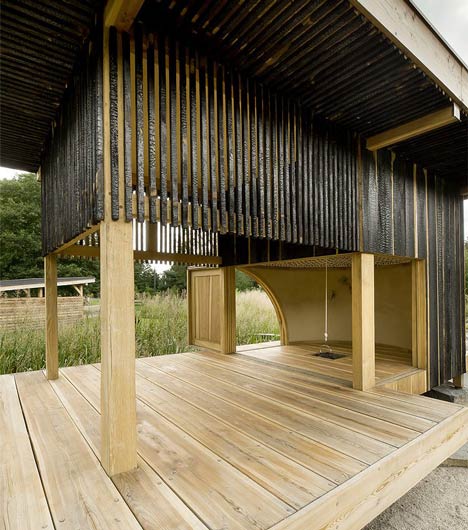
Teahouse
The inner space of the teahouse could be adjusted by the sliding doors, so there are more levels of perception of nearby landscape. One could enframe his own preferred view as a painting in the interior.
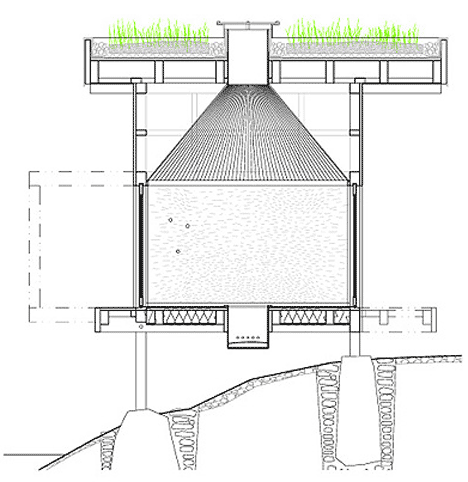
There is a play of sunbeams in gilded skylight, when the teahouse is closed. The whole interior is crowned with knitted geometry of cone soffit made out of sisal ropes. The hearth is the central point of the room, from which the space flows to large veranda built with larch planks.
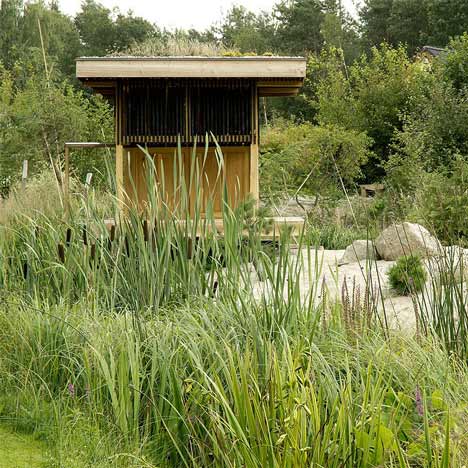
The veranda is a unique space for watching the water level and the life beneath. There is another important motif next to the knitted soffit in the interior, it is a rounded wall with clay plaster which integrates three bamboo vases as a reminiscence of famous japanese tokonoma – the niche for flowers and caligraphy.
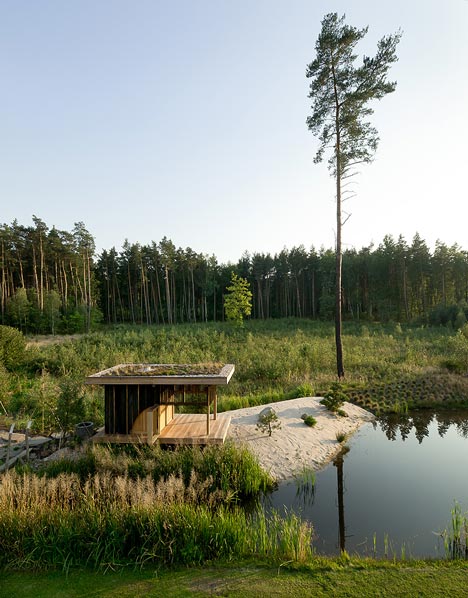
The Teahouse is carefully designed to become a natural part od the landscape and so the green roof is a fragment of grassy surroundings.
The whole house is covered with charred larch facing.
Authors: Lenka Křemenová, David Maštálka / A1Architects
Place: Czech Republic, Česká Lípa
Carpenter: Vojtěch Bilišič, Slovakia
Interior area: 3,50 m2
Veranda area: 10 m2
Realization: Spring 2011
See also:
.
![]() |
![]() |
![]() |
| Tea House by David Jameson |
Hat Tea House by A1Architects |
Tea house by David Maštálka |


how do you empty water from the vases attached to the wall?
you don't put in water… everyday a fresh flower…
Is that all what you have to say? what a `smart`comment, as you can see the vases are small (made for flowers) and they will dry out fast, no need to empty them.
You left out how intricate this project is, and focused on one little detail, so you are one of `those` who just makes bad comments all the time to sound smart.
A siphon of course. If in fact there is any need to empty the water.
Charred larch? I cannot understand the appeal of this as a finish, Any enlightening comments would be welcome. Paint it black; coat it with bitumen; but why burn it?
you will never understand.. Real architects don't put fake or temporary finishes on their work. It would look ridicoulous when paint starts peeling off after rain. Can you imagine the horror if architects started building with concrete and then painted it to look like red bricks?
Minimalist, and independent from the coddling of a modernized industrial complex, in short, D.I.Y.?
Early man was able to create a smooth, slick, hardened surface by exposing a sharpened spear tip to fire.
Also see: Burnishing
That's a traditional cladding material still used for Japanese house in Okayama Prefecture.
The charring of timber is a traditional preservative method used in japanese timber construction. More common techniques, as you suggested, may help preserve the timber for longer but I find that this method embodies a basic human relationship with fire. Fire being something that has played a massive role in the survival and development of the human race – when used responsibly of course!
One day I was justing wonder why a building facade picture looks soooo cool, and found out that it was burnt!! And then someone did this in real, like this designer! I would love to live in a house with charred facade. Poetic, Gothic, Hippie, all and more!
As a place to inspire inner contemplation, this tea house looks like a great success :)
Make's me want to put the kettle on! :)
How much more magic could it be in this place? Simply sstonishing!
Charred wood is a traditional building material in Japan. It's used to preserve wood and actually makes it more fire resisiant. Terunobu Fujimori uses it also.
Edward, charred larch ages slower than exposed or painted wood.
Charring changes the materiality (texture, smell, reflectiveness) of the surface in a way that painting etc doesn't. It also has poetic associations appropriate to a tea house (poverty of material, fleeting transience of life etc).
Cue the Fujimori rip offs.
they are working from similar traditional forms and methods, that doesn't mean it;s a rip off.
definitely not a rip off. all artists and creative people utilize ideas from the past. it is impossible to avoid and is what allows creativity to survive and thrive. burnt wood as a finish material is exquisite, had previously only seen it used as a treatment for wood in contact with the ground – natural 'pressure' treated.
not just less but much less with a kind of depth of which only the architect can appreciate. charred surface included.
Oh it's Fujimori!!
Am trying to find information on how best to mill and char larch for cladding. We have had to clear fell our Larch and now want to use it as cladding on our Dartmoor granite home. Have seen charred larch used before and love the soft play of light on the charred grey and black surface. Need info on how to do. Any useful links Please?