Stamp House by Charles Wright Architects
Australian firm Charles Wright Architects used a mixture of precast and in-situ concrete to construct a house that can withstand the most powerful cyclones in northern Queensland (+ slideshow).
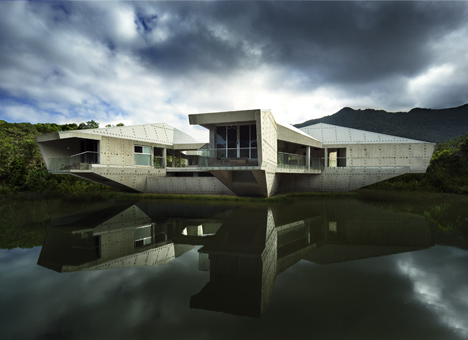
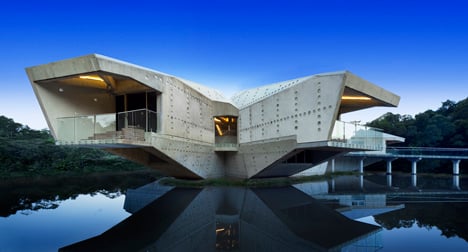
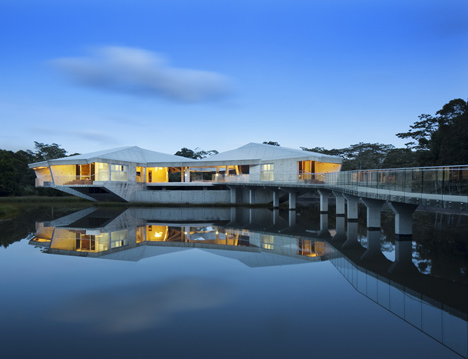
The two-storey residence hangs over the edge of a lake in a beachfront rainforest area that is prone to tropical cyclones at the top end of the meteorological scales. The chunky cantilevered volumes are not only strong enough to withstand these cyclones but also prevent water from getting in during any accompanying floods.
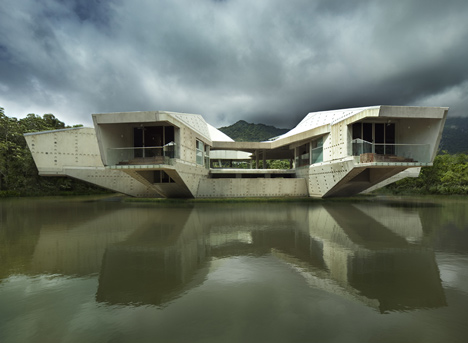
Charles Wright Architects designed the building to be self-sufficient, so it functions entirely off-grid. Solar panels on the roof generate electricity, while a 250,000-litre water system lets residents take advantage of rainwater harvesting and grey-water recycling technologies.
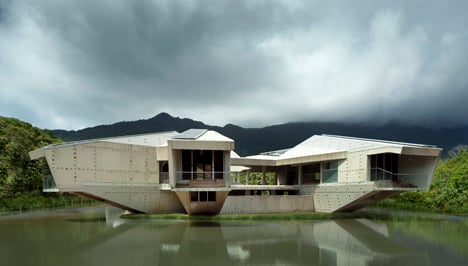
"The aim was not to simply produce an engineered outcome," explain the architects, "but to produce a building which made the most of the site's natural amenity and reintroduced the surrounding native wetland environment."
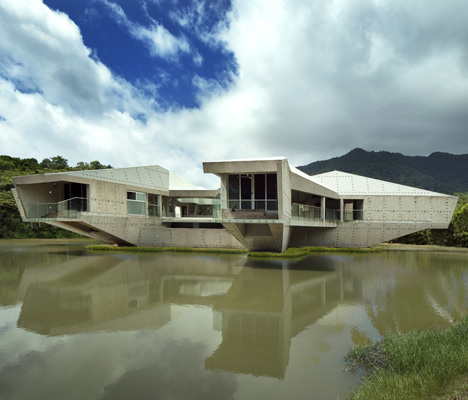
Named Stamp House, the building has an embellished exterior featuring a grid of circular indents that dot across the walls and roof.
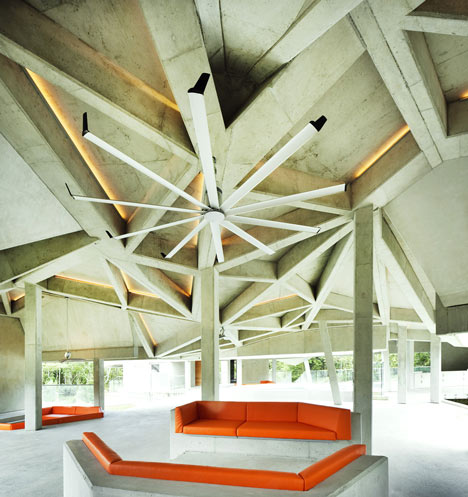
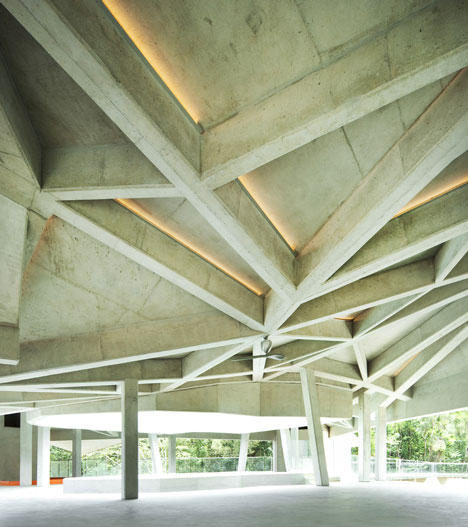
The entrance to the building is located on the uppermost floor and is accessed by crossing a long bridge over the water. Inside, a large central living room accommodates various seating areas, a kitchen, a dining room and a gym. Bedrooms are situated in the wings.
Other houses designed to withstand intense weather conditions include a concrete bungalow on a Japanese island prone to typhoons and a conceptual tornado-proof house.
See more houses in Australia, including a blackened-timber residence outside Melbourne.
Here's some more information from Charles Wright Architects:
Stamp House
CWA were approached by the project client to deliver a carbon neutral (in operation) solution for an environmentally sensitive site off-grid on the edge of the FNQ beachfront rainforest. The aim was not to simply produce an engineered outcome but to produce a building which made the most of the site's natural amenity and reintroduced the surrounding native wetland environment. The building is literally reflected by way of its siting over an engineered water ecosystem which was the result of lengthy liaison and collaboration with National Parks, Environmental Agencies, State and Local Government.
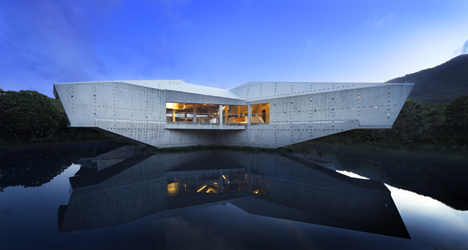
The design is formed in an innovative combination of in-situ and precast concrete. The concrete has been engineered and insulated incorporating a total solar panelled roof to provide for a constant cooler and more comfortable ambient temperature year-round. The design utilises massive cantilevers to mitigate impact from potential flooding and king tide inundation associated with cyclonic activity. The project has been designed to be solid and to withstand intense cyclones.
ESD initiatives include: total 250,000 ltr water harvesting, recycling and reticulation, renewable solar energy generation with solar backup non-reliant on fossil fuel backup generation, On-site Advanced Tertiary Sewerage treatment plant, grey water recycling and irrigation, Shaded and Insulated Thermal mass engineering, 'green' cooling and energy conservation controlled via building automation system (CBUS).