Wooden Mesh by Diego Vencato
Italian industrial designer Diego Vencato has created a collection of wooden textiles (+ slideshow).
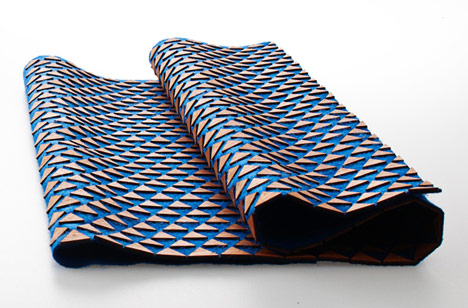
The fabrics, called Wooden Mesh, were designed to transform wood into a soft and flexible material that behaves more like cloth, Diego Vencato says.
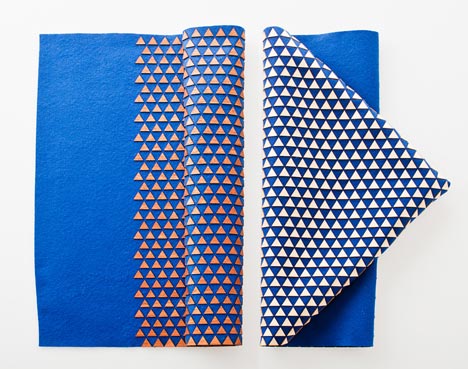
Thin pieces of wood were cut into small shapes and applied evenly onto a felt backing.
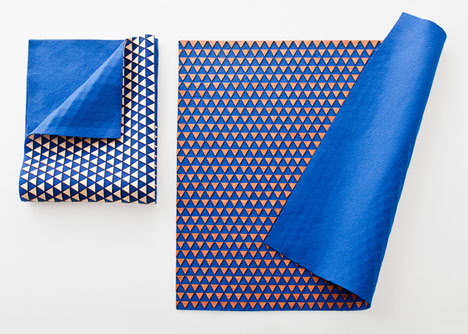
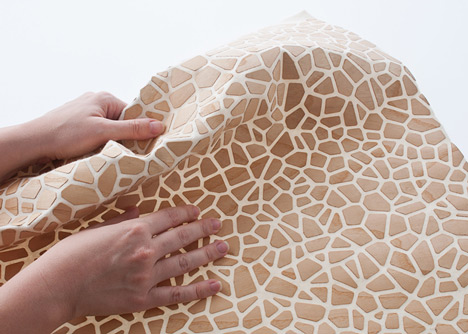
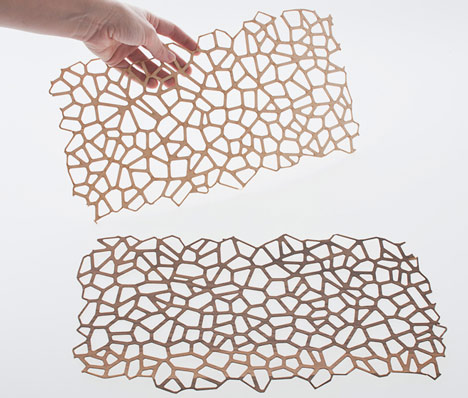
The patterns include neatly ordered triangles, sharply angled parallelograms and smooth-edged shapes that resemble a giraffe's markings.
We've previously featured a carpet made from wood veneer offcuts and a T-shirt made from triangles of wood, while Icelandic fashion designer Sruli Recht presented garments made of wood in the menswear collection he launched earlier this year.
Other textiles we've featured include an installation of hundreds of fabric ribbons and fabrics printed with bleach to spell out coded messages – see all textiles.
Here's some more information from the designer:
Wooden Mesh by Diego Vencato
A high-tech patented process to create the "wooden mesh", a compound which combines a rigid material to a flexible support. The wood goes through a metamorphosis process to become a new kind of skin.
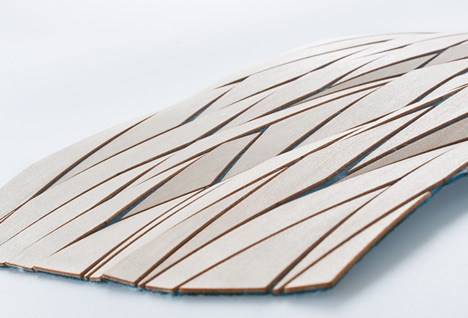
Transforming wood, making it possible that it not only could be flexible or soft, but it could also behave exactly like a cloth, was the idea behind the project.
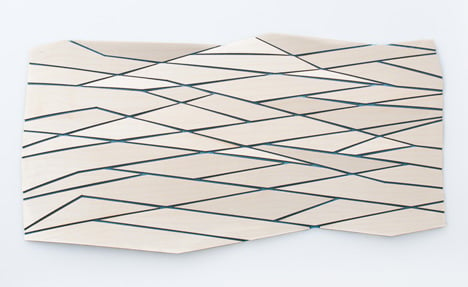
To turn wood into fabric we had to break the continuity of its surface, which we obtained by dividing it into pieces. Wood, organised as in polygons, was then coupled with the fabric, which acts as a support and a binder at the same time.
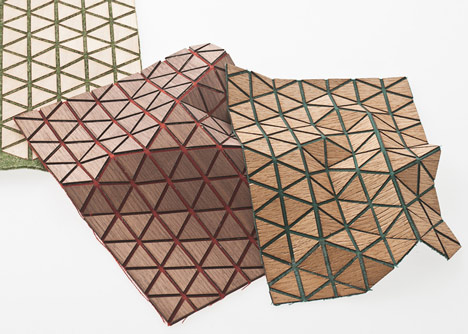
This is how we created "Wooden Mesh", a compound – realised through a high-tech patented process – that combines a rigid material (parent material) to a flexible support (secondary material).
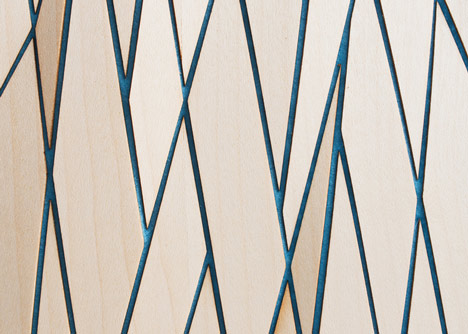
The goal was to move beyond the hand-crafted production to create an industrial product that had a more suitable cost for the market. This was possible thanks to the major contribution of Sintesi Laser and Alberto Martinuzzo, founder of Albeflex and "father" of the soft wood. Now the two-dimensional surface of a piece of wood has been completely transformed to become as smooth and soft as fabric.