


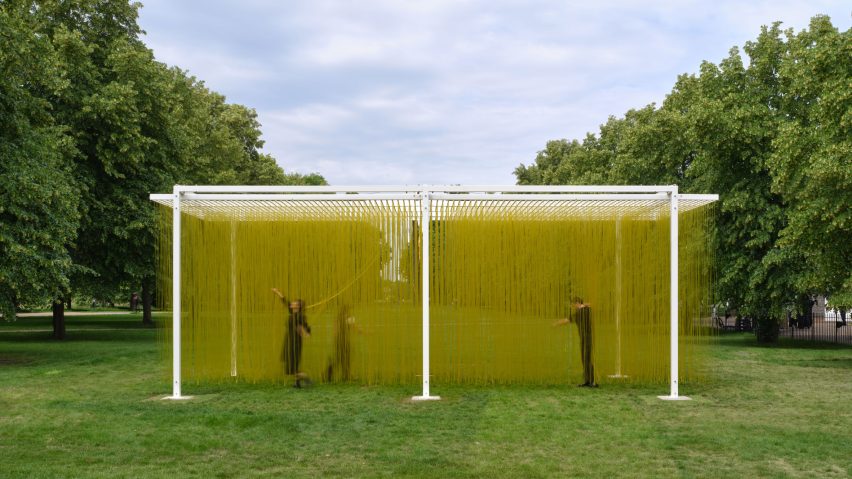
The Serpentine has installed a colourful, kinetic sculpture by Venezuelan artist Jesús Rafael Soto alongside this year's Lanza Atelier-designed Serpentine Pavilion in central London.
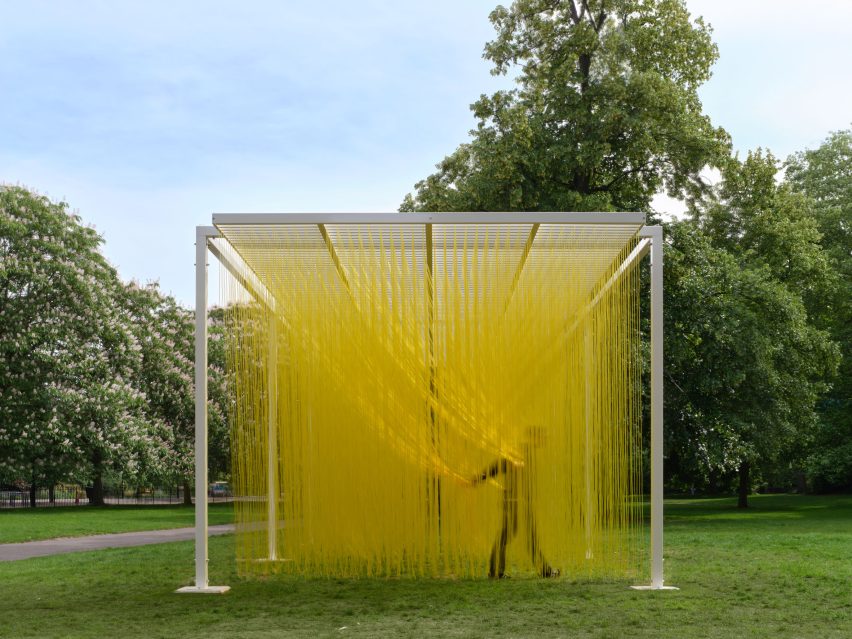
Named Pénétrable BBL Jaune, the kinetic pavilion is the first work by the artist, who passed away in 2005, to have been shown outdoors in the UK.
The interactive sculpture, which forms part of Soto's Pénétrable series, was selected for the gallery's art programme by a team including Serpentine artistic director Hans Ulrich Obrist.

"I met Jesus Rafael Soto in the early 2000s, several times in Paris, and recorded long conversations with him, and have ever since been very fascinated by his work," Obrist told Dezeen.
"How he really developed participatory kinetic work, how he managed to somehow dissolve objects into vibration, into to energy," he continued.
"Pénétrable are a real invention, they allow visitors to enter, to go through, [so it] goes from an object to a relation and we felt that would be amazing as part of our public art projects to do it in the park."

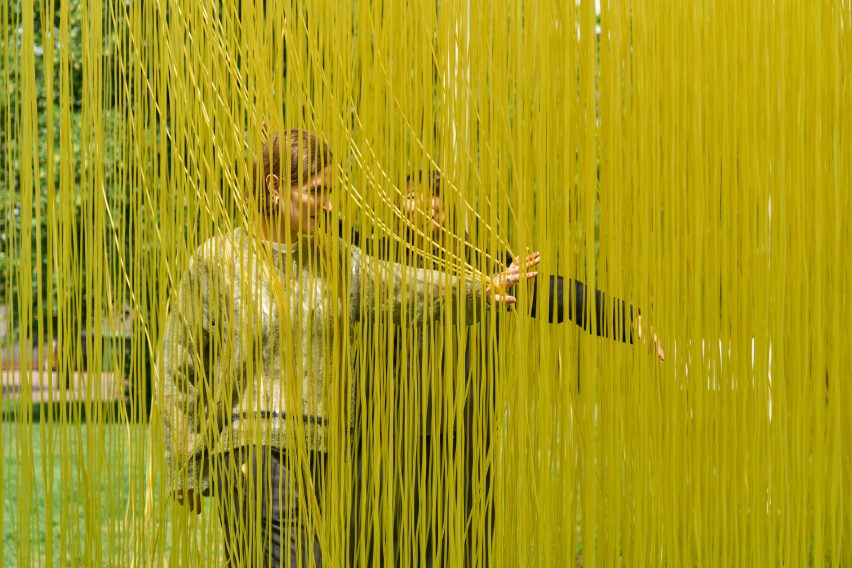
The pavilion, which was originally conceived in 1999, has a white steel frame from which thousands of yellow tubes are hung. Visitors are invited to walk through the sculpture and move the tubes to change how the piece appears.
It has been installed alongside this year's Serpentine Pavilion in Kensington Gardens in the same location as last year's Lego Play Pavilion, which was designed by architect Peter Cook.
"Last year we added a second commission in summer to the pavilion, the Lego pavilion of Peter Cook," said Obrist.
"And basically we decided that it would be interesting to have something very playful, something also for all generations, but including also children, to interact every summer," he continued.
"Sculpture in the park is an important part of what we are doing, but we wanted to extend that to have a type of play project every summer, so this is why, after Peter Cook, we timed the Jesús Rafael Soto to take place this summer."
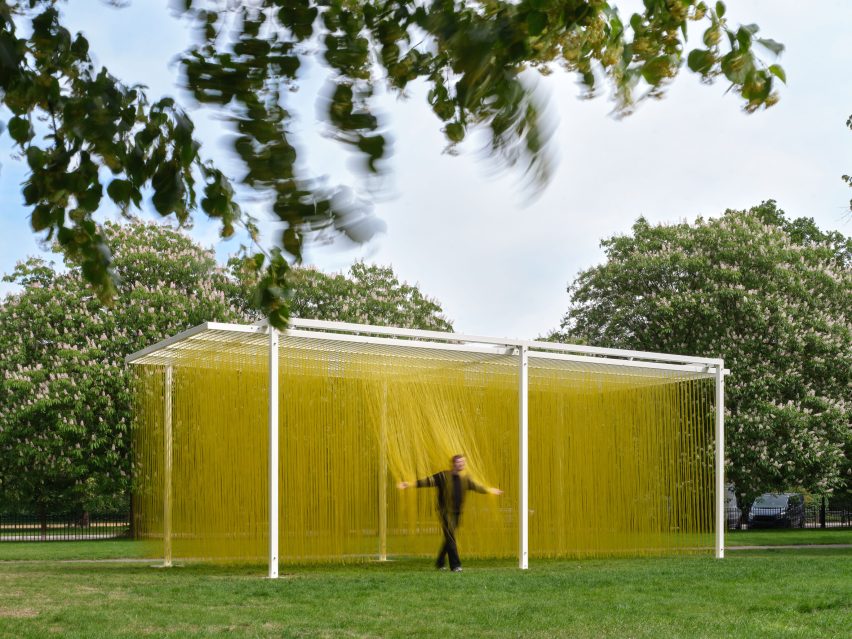
Although the sculpture was commissioned separately from the nearby Serpentine Pavilion, Obrist believes that the two structures complement each other.
"The public sculptures do not have a direct relationship, they're not basically commissioned together with the architect of the pavilion," he explained. "They're a separate project, but we feel that the playfulness of Soto works very well with Lanza Atelier."
"We also think that the idea of celebrating with Soto, a pioneering artist who hasn't really had visibility in the UK seems important to us, because while he was one of the really key artists of his generation, his work has not really been seen in the UK."
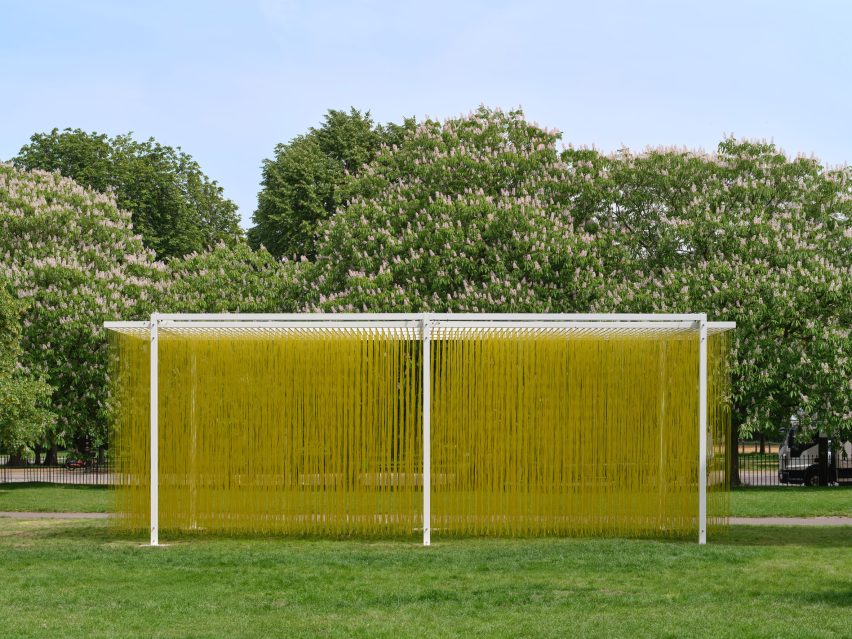
In particular, Obrist highlighted that both the sculpture and the Serpentine Pavilion play on the idea of turning something impenetrable into something that you can pass through.
"The connection, of course, between Lanza Atelier and Jesús Rafael Soto's Penetrable is that both of these projects actually take something that, in theory, is a barrier or a wall or a solid mass and convert it into a passage," he said.
"What Soto does is dissolve the object into these hanging elements, which then have a relationship with your own body, [as you] go through it," he continued.
"At Lanza Atelier's A Serpentine, there is something similar happening, because the crinkle, crinkle walls, and also the brick columns, they have a kind of a sequence of apertures and the wall ceases to divide."
This year's brick-walled Serpentine Pavilion, which was designed by Mexican studio Lanza Atelier, opened to the public earlier this month. In an interview with Dezeen ahead of the opening the studio said that "it was time to bring new Mexican architecture to the table".
The photography is by George Darrell, courtesy of Serpentine.