


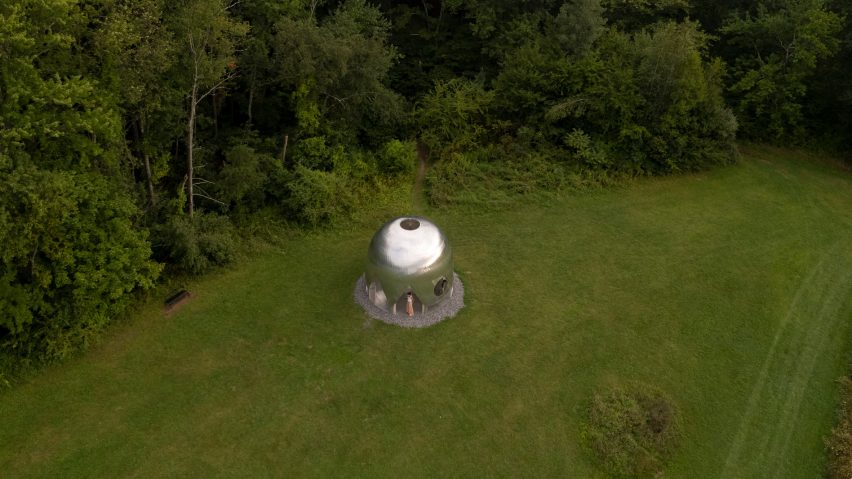
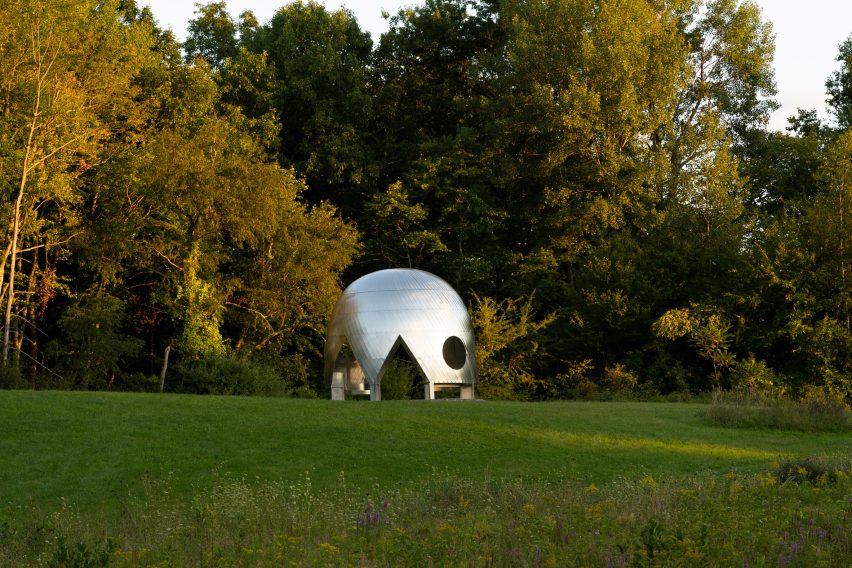
US studio MOS Architects has used aluminium shingles to cover an egg-shaped pavilion at Art Omi in Upstate New York, creating a place to rest that draws stylistically on pre-modern basketry and mid-century futurism.
An experiment in form and material, A Dome with Four Oculi was installed on the expansive Art Omi campus as a place of shelter and rest.
The structure sits on stilts and consists of a shell that MOS compared to a crinoline dress.

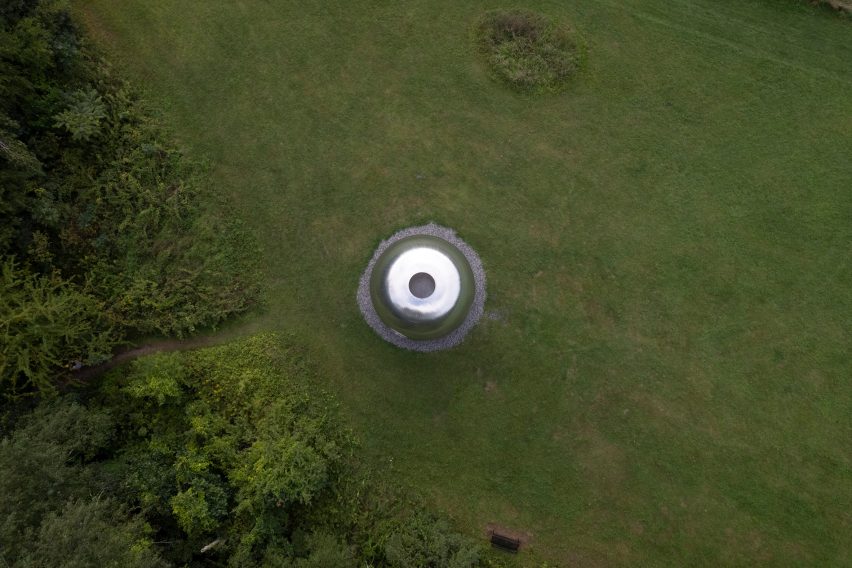
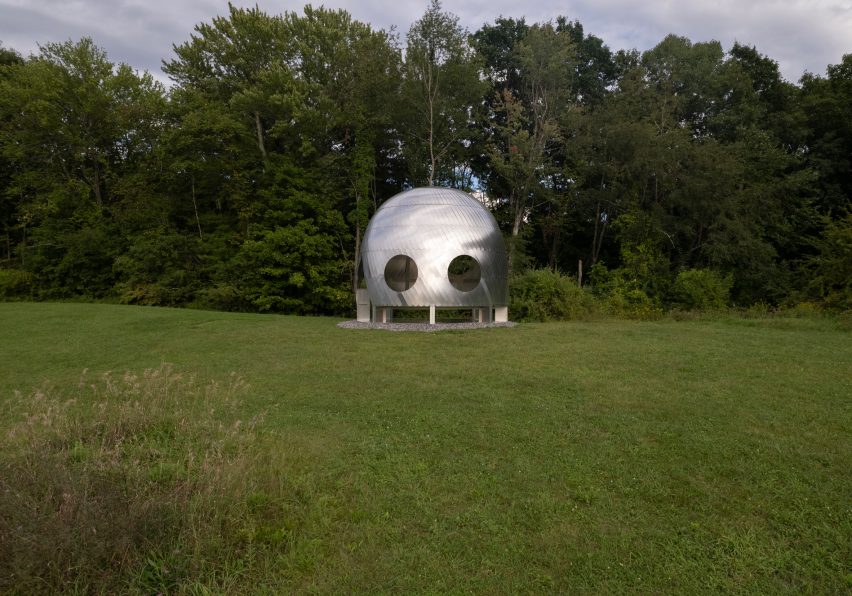
It was then covered by aluminium shingles that overlap and are held in place by stainless steel bolts. Combined, the shell is around a quarter-inch thick. It has two portholes on the side that look out into the landscape and is open at the top.
MOS co-founder Michael Meredith told Dezeen that structurally it is like an "upside-down basket", connecting to both the studio's work in easy-to-assemble prefabricated aluminium structures and a focus on the potential for experimentation at small scales.
"We've been working for years with folded aluminium and basically using it like paper, almost like large-scale models," said Meredith.
It was designed to be put together with standard tools in just a few days.
Conceptually, the structure takes cues both from pre-modern basketry as well as from the Airstream trailer.

"There's something of woven architecture in it, almost pre-modern," said Meredith. "Woven structures have an economic use of material, lighter material in this case. There's something nomadic."
"But there's Airstream trailer quality too," he continued. "You can see a bunch of stuff in it."

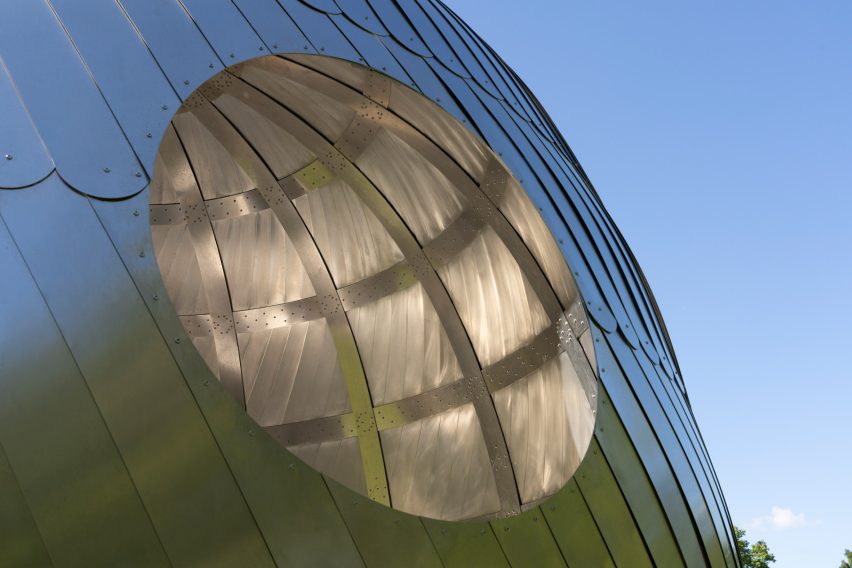
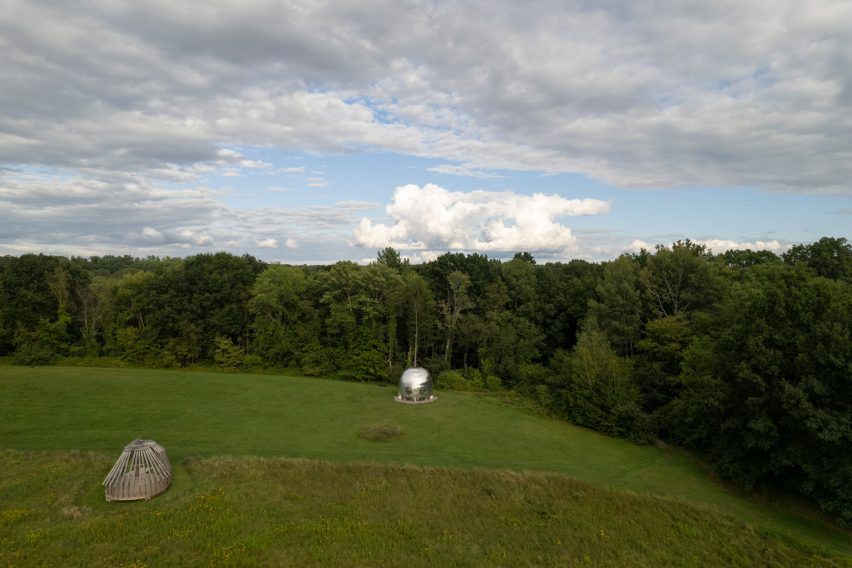
Beyond the thematic elements, the structure also provides shelter and a place to sit in the fields of Art Omi, which hold dozens of rotating art and architecture installations.
The oculi on the sides of the structure also provide vistas across the field.
Triangular cutouts on the side provide access and give the structure as in a tent.
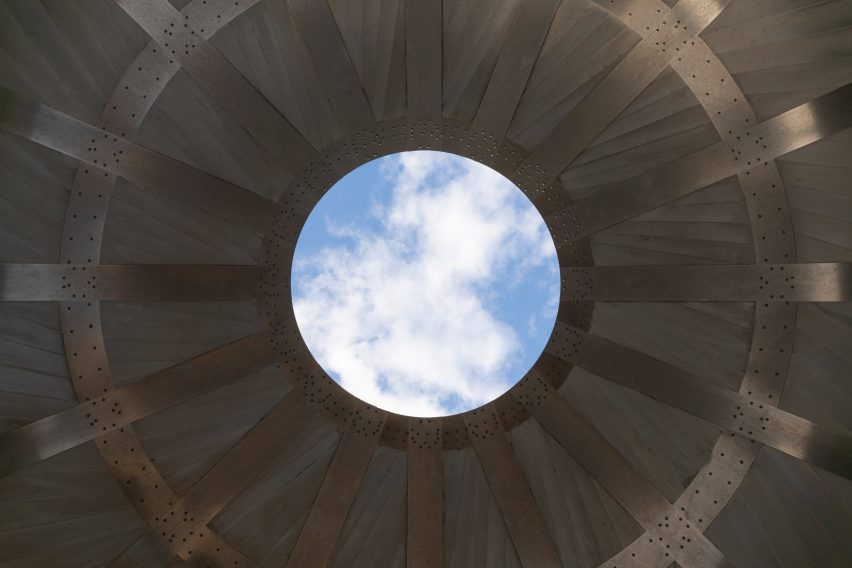
Viewed from elsewhere, the pavilion has a face-like quality. It almost looks like the top part of the head of the Iron Giant from the 1999 film.
"It's also, as everybody tells us, a little bit ridiculous," said Meredith, who said it was like a Buckminster Fuller dome reimagined by artist Philip Guston. He added that the woven nature of these structures makes it more practical than typical domes, as the sides could be modified and shaped as in basketry.
MOS is well known for its conceptual work and writings.
A Dome with Four Oculi relates to recent writings by the studio, such as its Smaller Architecture book, which calls for smaller architecture studios to experiment.
It was developed partly in response to what Meredith calls a "weird moment" for architecture. The prevalence and desire for bigness have left out an important space that architecture holds for expression.
"Architecture is in a weird moment in general. It used to be a more active part of cultural production," he said.
"At some point, though, it sort of shifted and just feels commercial. Everything just feels like a commodity," he continued.
"So that's what's nice about Art Omi. It's sort of outside the system, and it gives you a chance to reflect and think about something else."
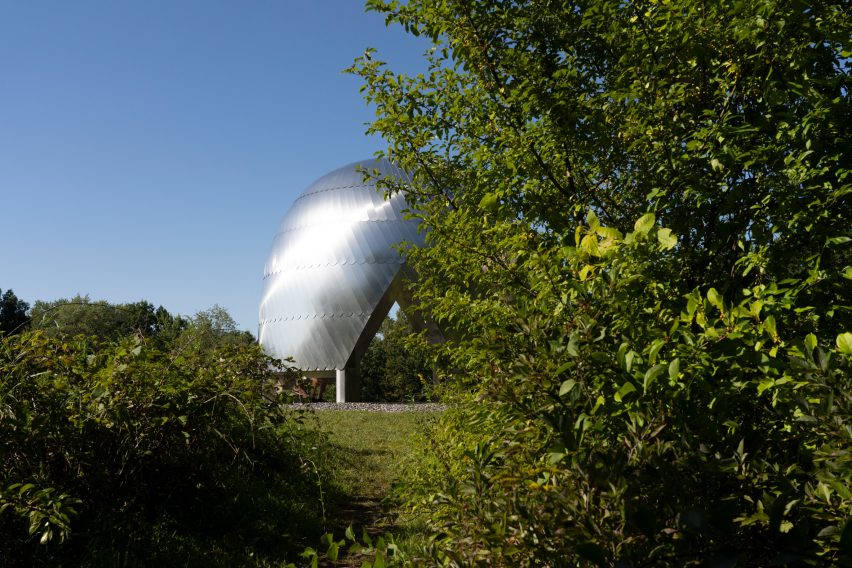
The pavilion was part of Art Omi's fall architecture programming, which included TAELON7's Limbo Engawa pavilion.
Art Omi has been doubling down on its commitment to architecture and, in 2024, announced a series of 18 pavilions designed by established architecture studios such as SO-IL.
In London, Studio Saar created a shield-topped pavilion for London Design Festival, examining Britain's colonial history in India.
The photography is by Michael Vahrenwald.