


Dezeen School Shows: a centre dedicated to nuclear learning set within the historic landscape of Stowe, UK, is among the projects by students at Cardiff University.
Also included is an ecology centre designed around the transparency of its AI use, and a community-driven recycling centre that gives unwanted items a second life.
Cardiff University
Institution: Cardiff University
School: Welsh School of Architecture
Course: Master of Architecture (MArch)
School statement:
"The Welsh School of Architecture (WSA), based in Cardiff, is a world-renowned institution for design and built environment studies.
"Originally founded over a century ago, the WSA has a strong tradition of excellence in architectural education; our teaching and research embrace the diversity and transdisciplinary nature of architecture.
"We foster curious, creative, critical, ethical learners who can approach challenges with wide-ranging, flexible skills and knowledge.
"Our vision is to contribute to the making of built environments that enhance the well-being of current and future generations while caring for the planet.
"The Master in Architecture (MArch) is a two-year programme. Accredited by RIBA, ARB and LAM (Malaysia), the programme encourages students to forge a personal stance informed by critical, reflective, creative and interdisciplinary approaches to design.
"In the first year of the MArch – the year of education in practice – our students undertake academic and project work while based in paid employment in an architectural practice.
"The second year, by contrast, is spent entirely in the school. Here, students develop grounded but research-led study through a dissertation and design thesis, whilst also undertaking studies in the practice, management and economics of architecture.
"Through the design thesis, each student initially identifies a site and topic for exploration that is framed within the context of a thematic design unit.
"They go on to use design as a vehicle for research and the development of imaginative architectural propositions."

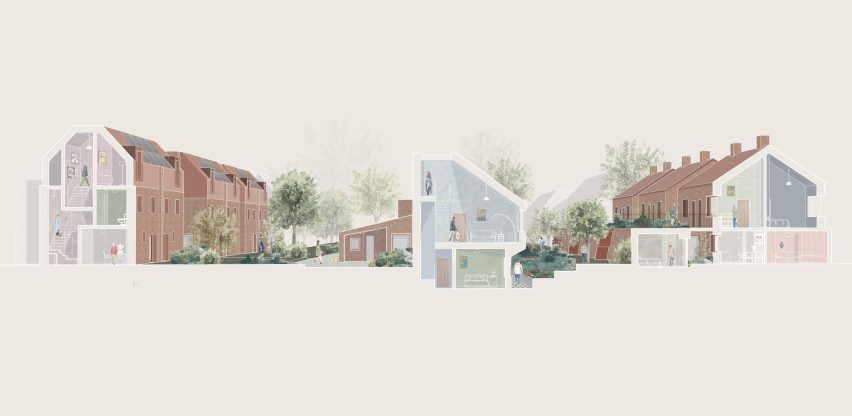
A New Garden City: Exploring the limits of Densification and Quality within a Pre-established Neighbourhood by Ruby Staple
"A Garden City for Tomorrow proposes a densification and decarbonisation framework for Ely and Caerau, providing 103 new PassivHaus homes while upgrading existing ones to EnerPhit standards.
"The prototype tests how far density can increase without reducing housing quality, balancing sustainability, spatial beautification and community needs.
"The scheme proposes improved thermal performance and expansion of housing through active community engagement, which would ensure future strategies better reflect local priorities.
"Overall, it offers a provocation for low-carbon, socially connected neighbourhood design beyond budget-driven mass housing."
Student: Ruby Staple
Course: Master of Architecture (MArch)
Tutors: Mhairi McVicar and Dan Benham
Email: rubiestaple[at]gmail.com

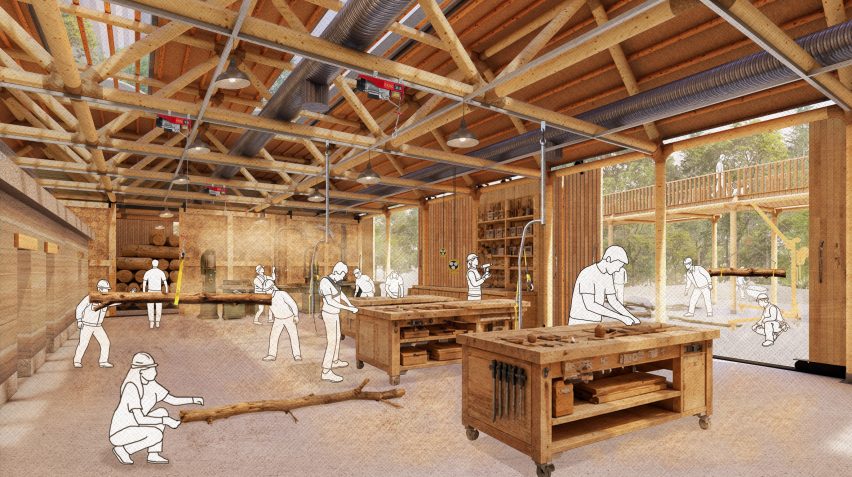
Building Futures by Éabha Strong-Wright
"This timber skills centre explores how architecture can create opportunities for young people through participation and connection to place.
"Located on the edge of an ancient woodland, the thesis transforms existing community and environmental assets, with a focus on construction and learning.
"Guided by a zero-waste design philosophy, it utilises site-sourced materials, focusing on roundwood construction and using every part of a tree. An experimental wood-fibre composite connector transforms workshop waste into a structural system.
"The proposal combines retrofit, landscape intervention and new construction to reconnect the community with the woodland while creating opportunities for long-term education and employment."
Student: Éabha Strong-Wright
Course: Master of Architecture (MArch)
Tutors: Mhairi McVicar and Dan Benham
Email: eabhasw02[at]gmail.com

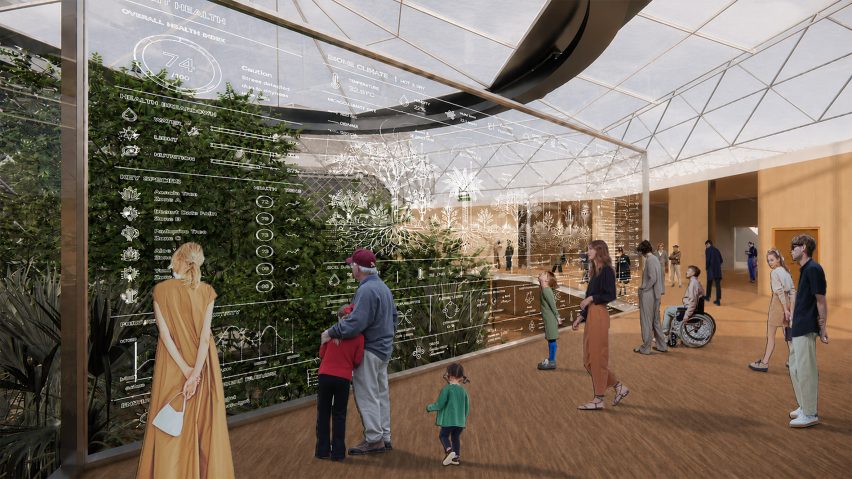
Cybernetic Ecology by Maisy Sykes
"Cybernetic Ecology explores how architecture can create a regenerative relationship between people, nature and technology.
"Located within the flood-prone landscape of Cumberland Basin, Bristol, the project reimagines the European headquarters of biotech company Insilico Medicine as a workplace for AI-driven ecological research and public engagement.
"Five climate-controlled biomes cultivate medicinal plants, while AI-controlled moving roofs and adaptive facades respond to changing environmental conditions.
"Principles of transparency expose hidden systems, from visible laboratories to AI server rooms where waste heat supports the building. The project makes artificial intelligence visible, understandable, and accessible to the public."
Student: Maisy Sykes
Course: Master of Architecture (MArch)
Tutors: Lawrence Duck and Shankari Raj
Email: maisy.sykes[at]icloud.com

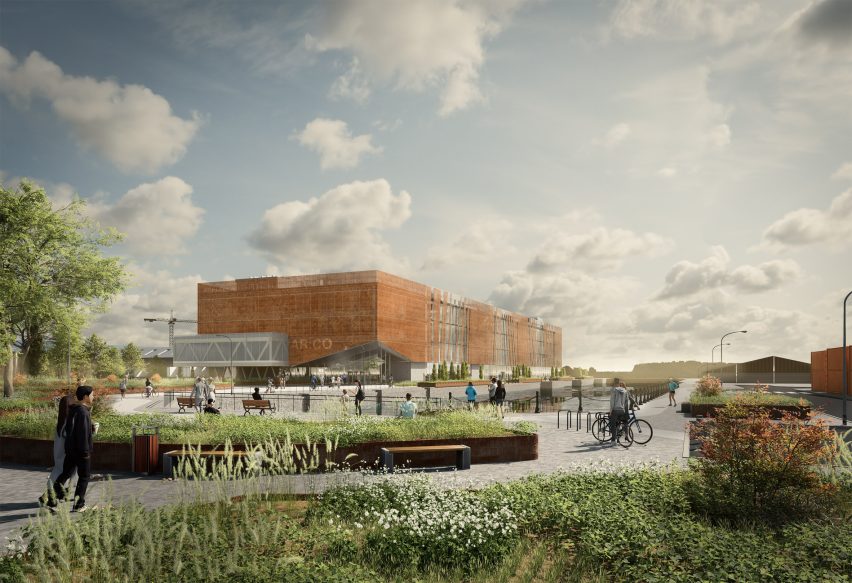
The Architecture Collective by Ollie Yelland
"As the built environment sector has become increasingly complex and hyper-specialised, the architect's role has fragmented, creating an industry where large corporate firms hold a distinct advantage.
"This thesis proposes a new collective framework designed to empower small architecture practices by cross-programming the fragmented disciplines of the construction industry.
"Drawing organisational inspiration from large practices and architectural schools, the project culminates in a collaborative professional hub located in Cardiff Bay.
"Deliberately situated away from the city centre's mega-firms, this spatial intervention provides a shared ecosystem for architects and allied professionals to pool resources, innovate, and reclaim industry agency."
Student: Ollie Yelland
Course: Master of Architecture (MArch)
Tutors: Mark Hillier and Yasser Megahed
Email: ollieyelland[at]gmail.com

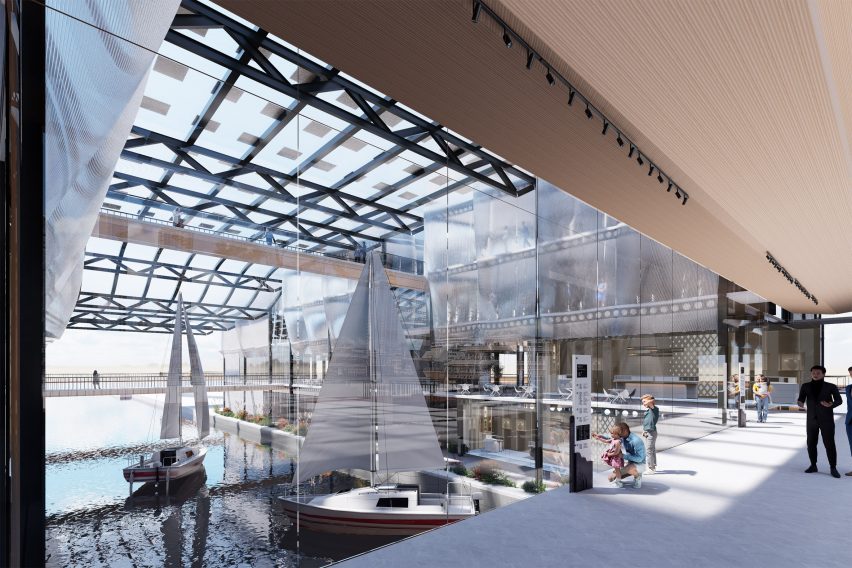
Below the Surface: Reimagining Competitive Sailing Infrastructure as a Mediator Between People and Performance by William Underwood
"The elite sailing industry often keeps people and place at an arm's length. It presents the sport as a spectacle to be admired from a distance, celebrating the product's performance over the people and processes that make it possible.
"In response, this project explores the concept of permeability, questioning how sport STEM centres might reimagine themselves as civic destinations without compromising competitive advantages or R+D secrecy.
"Through strategic voids and public cross-programming, the proposal creates an open, permeable centre, blurring public and private realms, allowing visitors to witness the inner workings of STEM activity through the lens of competitive sailing."
Student: William Underwood
Course: Master of Architecture (MArch)
Tutors: Yasser Megahed and Mark Hillier
Email: waunderwood[at]hotmail.co.uk

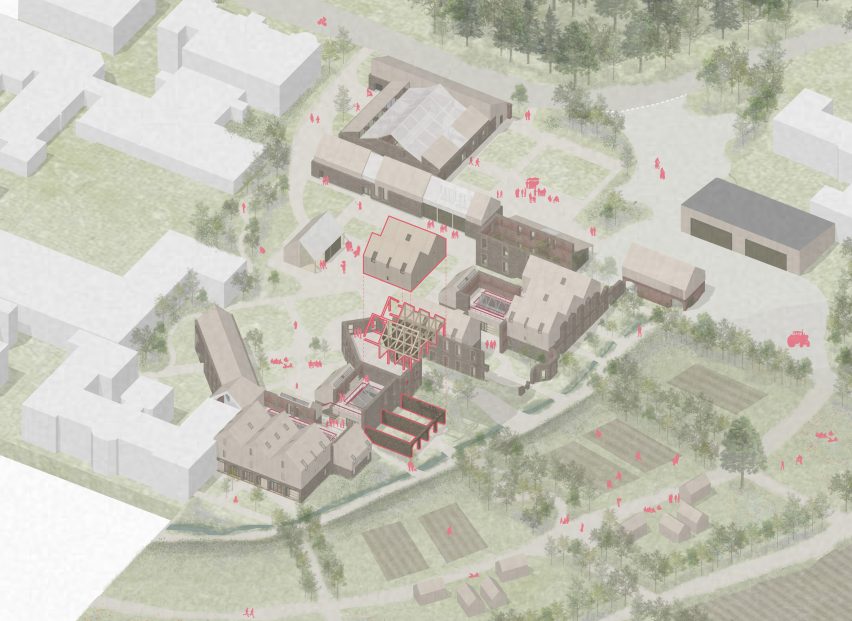
Cultivated Dwelling by Martha Spencer Jones
"This thesis re-imagines the abandoned Mid Wales Hospital as a place of cultivation and renewed human-nature interdependency, where gathering becomes the central driver for re-dwelling.
"Black Mountains College, young families, local farmers and the Talgarth community form a shared campus where regenerative farming, experimental growing, and communal workshops create a living framework for ecological learning.
"Grounded in primitive notions of dwelling, the thesis explores how historic forms of gathering can be repurposed, so that humans and nature can co-exist holistically.
"By reframing dereliction as opportunity, the project proposes a rural regeneration model that fosters climate resilience and interdependent living grounded in gathering."
Student: Martha Spencer Jones
Course: Master of Architecture (MArch)
Tutor: Marga Munar Bauza
Email: marthaspencerjones[at]gmail.com

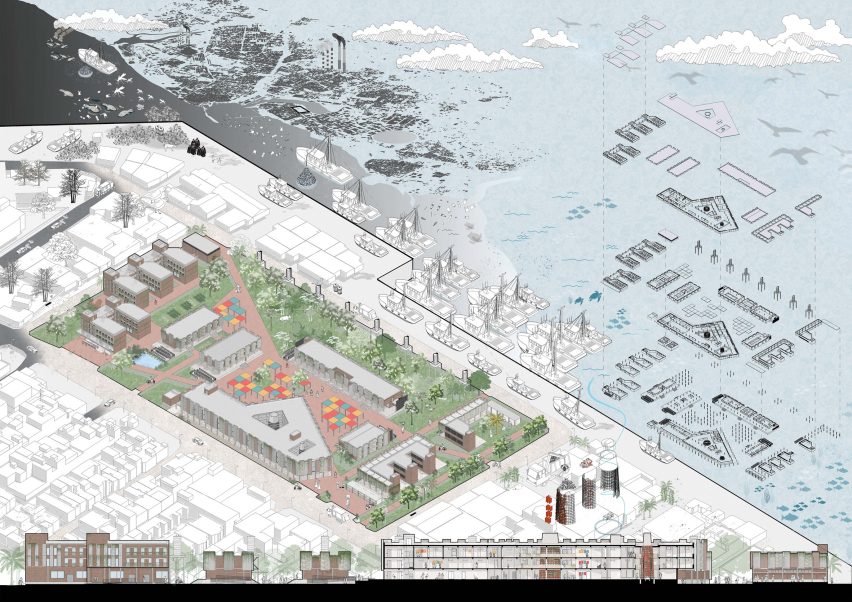
Somnath: Waste to Worth by Huriyyah Aiba Binti Nur Malek
"Today, the world is generating waste at a rate beyond its ability to sustainably manage it. Driven by population growth, rapid urbanisation, rising incomes and increasing consumption, cities face growing environmental and social challenges.
"Based in Somnath, India, the catalyst project proposes a community-driven recycling centre that gives unwanted items a second life, converts food waste into biogas, and treats wastewater for reuse.
"The proposal seeks to redefine perceptions of waste by transforming discarded materials into valuable resources that can be re-integrated into everyday life, reducing their impacts on our environment while fostering community participation and a more sustainable future."
Student: Huriyyah Aiba Binti Nur Malek
Course: Master of Architecture (MArch)
Tutor: Shibu Raman
Email: aibamalek[at]gmail.com

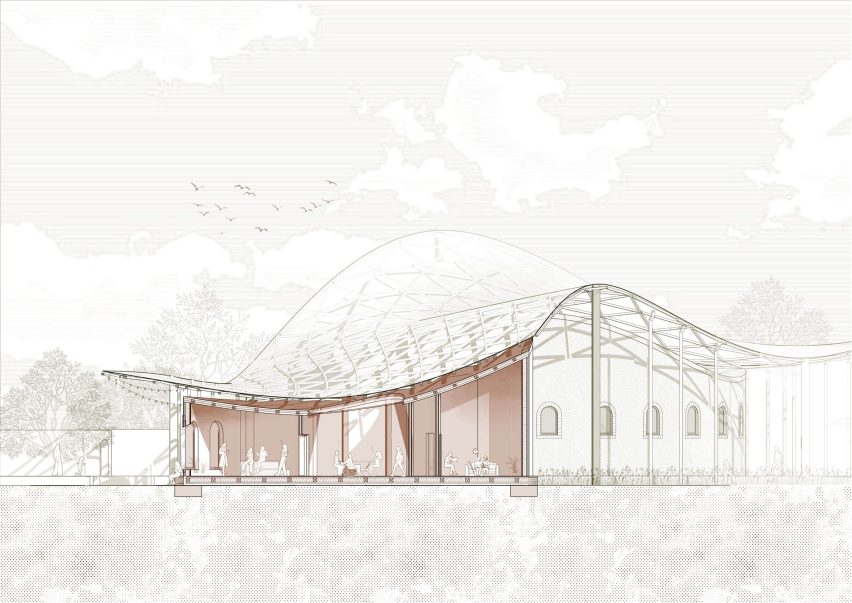
Ty Lles: Cardiff University's Home for Women's Wellbeing by Ella Coomer
"Tŷ Lles: Cardiff University's Home for Women's Wellbeing explores how architecture can address barriers women face in sport and movement.
"Situated within Cardiff University's campus, the project reimagines the sports facility as a holistic environment focused on care, wellbeing and community.
"The scheme positions architecture as a catalyst for empowerment and participation organised around four hubs: community, movement, wellbeing and health.
"The design supports physical activity, mental wellbeing, healthcare and social connection, defined by a sculptural timber gridshell canopy and organic forms, to create inclusive and calming spaces rooted in collective care principles."
Student: Ella Coomer
Course: Master of Architecture (MArch)
Tutor: Hiral Patel
Email: ellacoomer[at]icloud.com

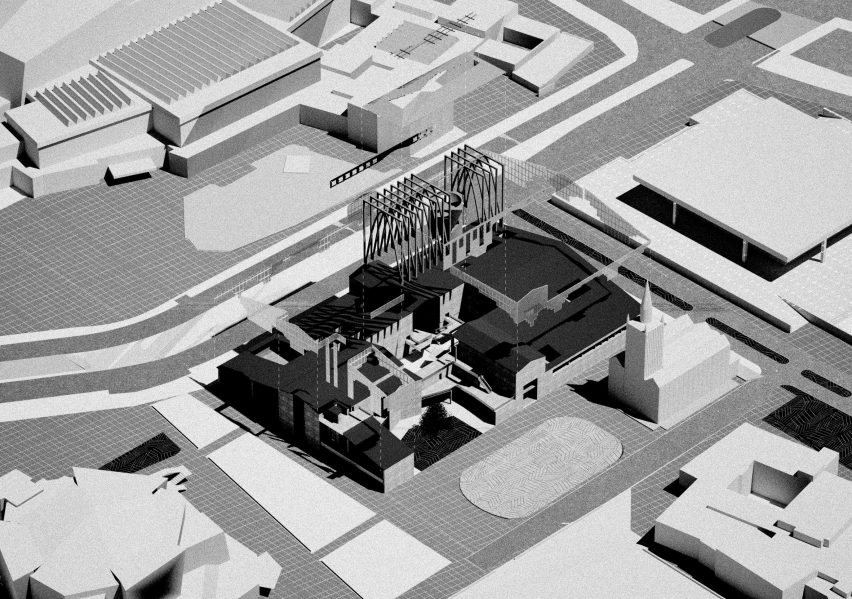
The Second Draft of Yesterday by Kenneth Dhillon
"The Second Draft of Yesterday confronts a building suspended between intention and completion: Herzog and de Meuron's Berlin Modern M20, frozen in construction at the Kulturforum, severing the civic dialogue between Mies van der Rohe's Neue Nationalgalerie and Scharoun's Philharmonie.
"The project asks what an architect's obligation is to an unfinished building, and answers through editorial intervention. Selected structural bays are erased to create civic porosity.
"The retained fabric becomes the ground; the erased voids become civic space. A copper facade records time, and a rotating brick Palimpsest Tower turns the building's logic inward. The pathological becomes propelling."
Student: Kenneth Dhillon
Course: Master of Architecture (MArch)
Tutor: Alexis Germanos
Email: kennethdhillon[at]outlook.com
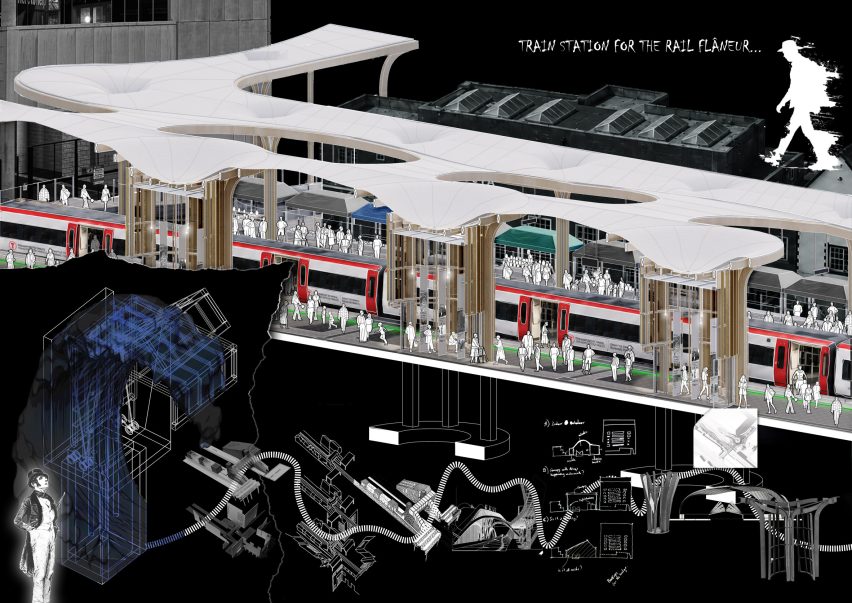
Deterritorializing the Railway Station, a Flâneur's Architectural Dream by Anastasia Stachtiari
"Small-to-medium railway stations make up around 80 per cent of the UK's rail network, yet remain underinvested. This thesis addresses this overlooked typology through an ecology of rail travel rooted in Wales.
"Drawing on situationist theory, it develops the concept of rail psychogeography, experienced through the lens of the flâneur, in which the railway journey becomes an experience of drift and discovery.
"The project challenges the present conventional typology, which is driven primarily by operational efficiency, arguing that the urban presence and architectural, social and civic value of small-to-medium railway stations are often underestimated.
"It asks how their components might be reimagined to support unconventional uses of platforms, kinetic crossings and flexible programmes that encourage lingering, wandering and exploration within stations and throughout the rail journey."
Student: Anastasia Stachtiari
Course: Master of Architecture (MArch)
Tutor: Will Judge
Email: anastasia.stachtiari[at]gmail.com

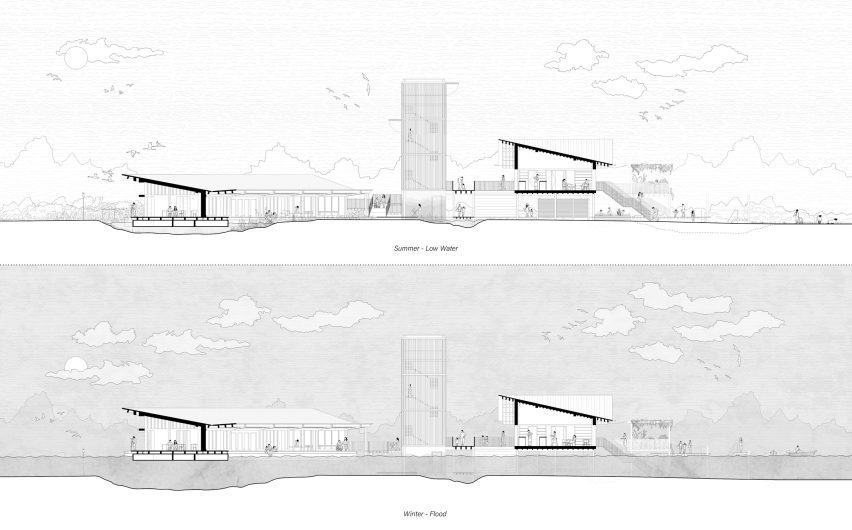
Reviving the People's Floodplain by Catherine Towers
"Located on the Severn Ham floodplain in Tewkesbury, the project proposes a flood-responsive civic and ecological landscape that occupies, rather than resists, seasonal flooding.
"A linear intervention, the Mowing Edge, separates a public commons and water-treatment landscape from restored floodplain meadow and wetland habitats, while functioning as resilient community infrastructure.
"At the threshold between Tewkesbury and the Severn Ham, elevated walkways, floating structures and adaptable public spaces remain accessible throughout changing water levels, supporting ecological restoration, environmental education, year-round recreational uses and flood resilience.
"The proposal reimagines flooding as a civic asset, transforming periods of inundation from disruption into opportunities for occupation, learning and engagement with the historically important landscape."
Student: Catherine Towers
Course: Master of Architecture (MArch)
Tutors: Andrew Carr and Reishin Kunishima Watabe
Email: catherinetowers22[at]gmail.com

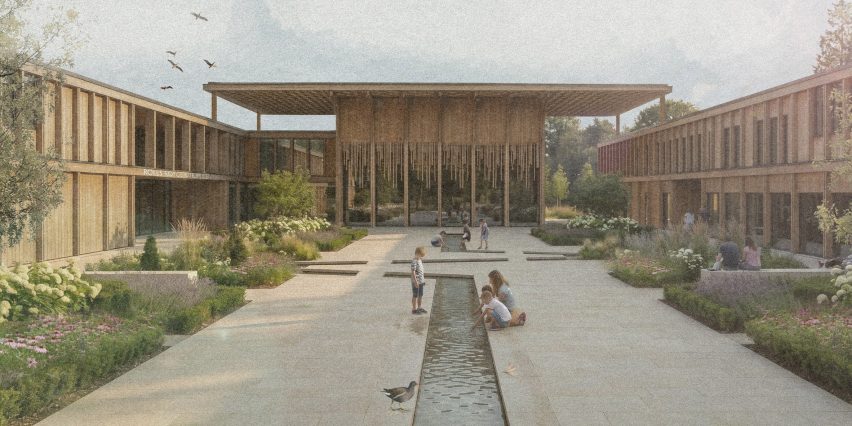
Learning in the Landscape by Amelia Farman
"Learning in the Landscape reimagines nuclear energy as civic architecture within the Oxford–Cambridge Arc.
"Responding to the rapid growth of artificial intelligence and its escalating energy demands, the project proposes a Centre of Nuclear Learning set within the historic landscape of Stowe.
"Drawing on the tradition of the English landscape garden and the villa as a place of intellectual exchange, the proposal combines research, education and public engagement.
"This thesis challenges the defensive image of nuclear energy, arguing instead for an integrated, culturally grounded masterplan that supports both technological advancement and civic identity."
Student: Amelia Farman
Course: Master of Architecture (MArch)
Tutor: Tim Burton
Email: ameliafarman[at]gmail.com
Partnership content
This school show is a partnership between Dezeen and Cardiff University. Find out more about Dezeen partnership content here.