Design Academy Eindhoven students
invite Milan to Eat Shit

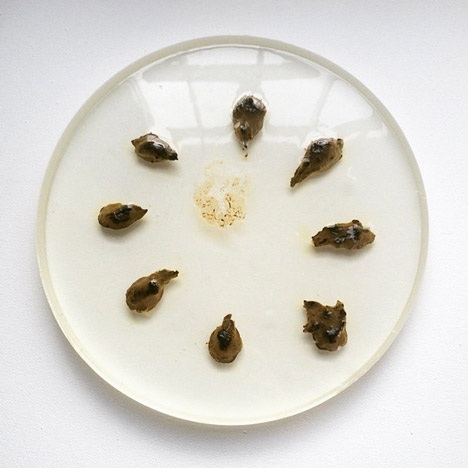
Milan 2015: mummified poo, intestine-shaped bread and a Portaloo festooned with flowers were among the projects presented by students from Design Academy Eindhoven‘s food design course during Milan design week.
The first exhibition by Design Academy Eindhoven‘s Food Non Food students – titled Eat Shit – was curated by course leader Marije Vogelzang and ran in the Ventura Lambrate district of Milan until yesterday.
The food design course is still in its infancy, with its first batch of students just eight months into their studies.
A bright red sign reading Eat Shit hung over a set of wooden gates dividing the entrance from the exit, a reference to the show’s topic – the human digestive system.
Inside, a range of projects investigating both ends of the human digestive system explored the processes involved in producing the food we eat and the repulsion typically felt to the excrement created from it.
“I was surprised that there was so little focused on and attention for the importance of food as a substance [prior to the course],” course tutor Arne Hendriks told Dezeen at the opening of the exhibition. “You have all these schools of people designing chairs and you have hardly any people thinking on a high level about food distribution on a designer level.”
“Our students are not food designers in the sense that they want to make beautiful food,” he continued. “They know that food is one of the most important topics for contemporary society to really look at.”
“Half the world is underfed, half the world is overfed,” added the school’s creative director Thomas Widdershoven. “Those really obvious things make you want to think about food again and work on it.”
A collective of three students – Aya Kawasaki, Adelaide Tan and Shaakira Jassat – set about overcoming the taboo around discussing human faeces.
“We are distant from our shit. This happens on a literal, perceptive and psychological level,” said the designers. “Shit, however, has immense potential. It can be recycled, turned into energy and has health benefits.”
In a project called Mummy Shit Lab, the students assigned themselves the roles of poo-producer, refiner and enhancer. The producer followed a strict diet and exercise regime for the duration of the project, and produced samples of excrement that were examined by the refiner, then freeze-dried and preserved in disks of epoxy resin by the enhancer.
The team hoped that by presenting the process, they could help themselves as well as visitors overcome the instinctive feeling of revulsion towards faeces.
“The essence of mummification is the beauty of something transitory and displeasing like death being given an extension of its time in a beautiful, glorified way,” said Shaakira Jassat. “After working on this project, every time I flush my shit away, it feels like a funeral – a goodbye to something I really find value in now.”
The students claimed that there are elements of the scent of faeces that are appealing once the initial feelings of disgust are swept aside.
To test out this theory before embarking on the Milan project, they surveyed the favourite foods of the school’s tutors and presented them with platefuls of excrement from a producer who had recently eaten the cuisine, with positive results.
Swabs of personal belongings and finger prints were collected by another group of students in a project called Invisible Visible.
Cultures of the bacteria present were then grown in petri dishes and used to map the types most prevalent in residents of different countries.
To investigate the impact on gut bacteria, one student ate only bread for the duration of the exhibition. Loaves of intestine-shaped bread were produced on site to fuel the diet in a project called Make Bread Not Chairs.
Other projects included a filtration system to convert urine into liquid fertiliser and a portaloo with planted flowers, while course tutor Hendriks created a dovecote made from bricks of pulped newspaper.
The Pigeon Poo Tower was designed as a prototype for how city-dwellers could use the resources around them to fertilise and produce their own crops, while providing the urban bird population with homes. “It’s like a five star hotel for pigeons,” said Hendriks.
Over 400 projects relating to food and waste from the academy’s history from 1976-2015 were detailed in a timeline around the wall of the exhibition space and a number of graduate projects were also on show.
These included a scent installation by graduate Mickaël Wiesengrün, who worked with Norwegian chemist Sissel Tolaas to recreate the smells that would have been present in the former factory space were among these projects. A Willy Wonka-inspired popcorn machine and a 3D printer that uses clay to produce vases were also shown.
In the exhibition gardens, Food Curators set up a food factory to serve breakfasts and lunches of savoury and sweet “sausages” made from mulched rice pudding and couscous.
The students ran an advertising campaign to drum up interest for the show. Wearing Teenage Mutant Ninja Turtle-style poo-shaped shells, they travelled around Milan handing out biscuits piped with swirls of brown and employed guerrilla tactics by targeting the billboard campaigns of brands such as Ikea with “eat shit” stickers.
Read more
Recommended stories
Milan universities team up to launch “unique” food design degree
Food is “the most important material in the world” says Marije Vogelzang
“We need creative ideas to change the food system” says Marije Vogelzang
Design Academy Eindhoven students reinvent the bathroom for a resource-scarce future
Design Academy Eindhoven graduates showcase work at Dutch Design Week
Seven student design projects that enhance the process of cooking and dining
Eight student architecture projects that focus on the food industry