Light Modulator by Studio Lazerian
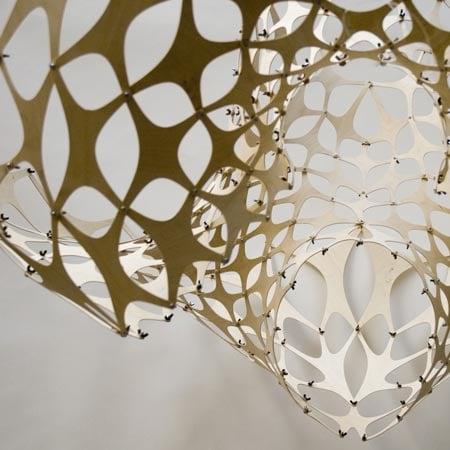
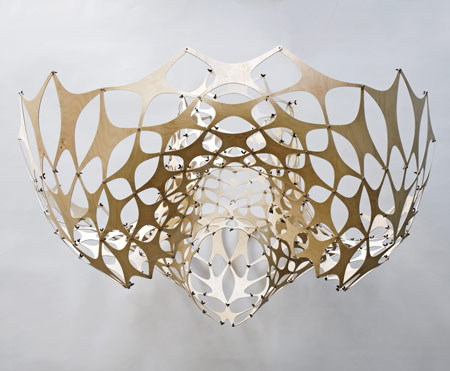
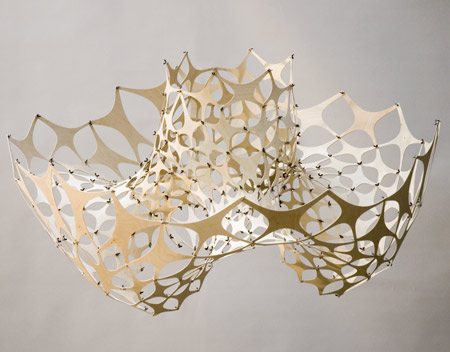
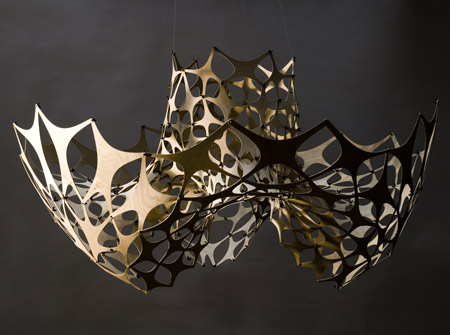
Richard Sweeney and Liam Hopkins of Manchester-based design studio Lazerian have designed a light shade made from modular, birch plywood components.
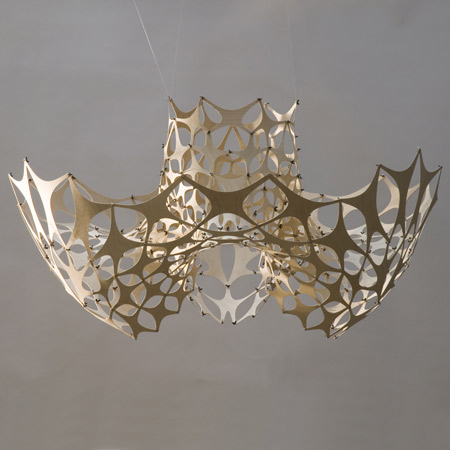
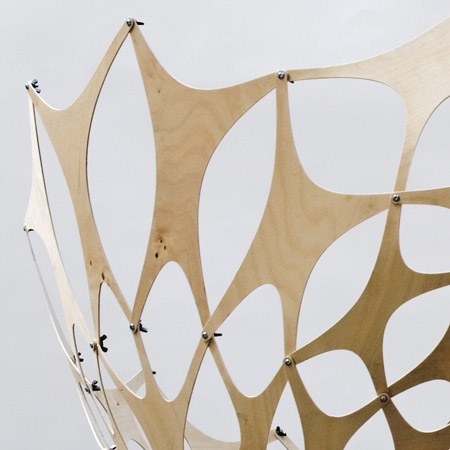
The shade is constructed from 1.5mm CNC-cut pieces, joined with bolts and wing-nuts. The design uses 26 unique components, repeated throughout the structure.
Photographs by Richard Sweeney.
The following information is from Hopkins:
--
Modular Form: Furniture by studio Lazerian
Liam Hopkins was born in Manchester, England, and studied a BA(Hons) in Three Dimensional Design at Manchester Metropolitan University (MMU), England.
Hopkins set up design studio Lazerian in Manchester, 2006, and has collaborated with artist Richard Sweeney on design projects from 2007 to present. Sweeney was born in Huddersfield, England, and met Hopkins while studying on the same course at MMU. Both Hopkins and Sweeney take an experimental approach to design, which is based upon the hands-on investigation of materials and processes, combining both traditional hand-craft and computer-aided design techniques.
A collaboration between Liam Hopkins and Richard Sweeney, the project which spawned the Light Modulator, Mensa table and Mensa coffee table was based upon a study of form in 1.5mm and 3mm birch plywood. The principle behind the working method was to discover means of creating objects through the use of a CNC routing machine, with a cutting bed size of 750mm2. Fabrication was limited to the use of glue or bolts.
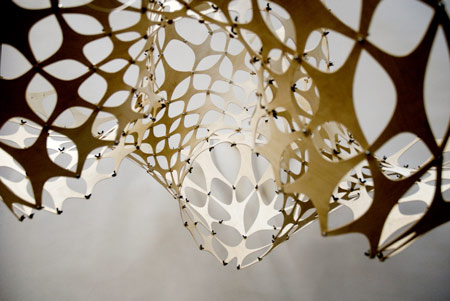
The use of hands-on modelling as a means of testing and developing form was employed from the outset. By manipulating plywood directly, the behavior of the material was used to develop shapes and structures. Factors such as grain direction, flexibility and strength were integral to the resolution of final constructions.
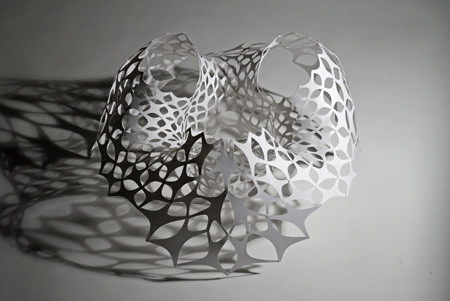
Material properties informed the development of computer models, which were used to create physical, paper maquettes before construction in plywood. By maintaining a material-led approach, the computer can be more effectively utilised in the creation of form, as an awareness of physical constraints has already been established. Embracing both hand-craft and machine process allows the exploration of ideas, which utilise the unique aspects of both approaches.
Light Modulator
Material properties informed the development of computer models, which were used to create physical, paper maquettes before construction in plywood. By maintaining a material-led approach, the computer can be more effectively utilised in the creation of form, as an awareness of physical constraints has already been established. The real aim of the piece was to discover how CNC cutting could be used to create modular forms in plywood. The idea of function was put to one side, with efforts being focussed on how best to utilise the flexibility and strength of birch plywood in conjunction with the cutting technology. The Light Modulator (so named as it casts a beautiful shadow)is the result of on-going experimentation carried out by Richard Sweeney and Liam Hopkins- founder of Manchester based design studio, Lazerian.
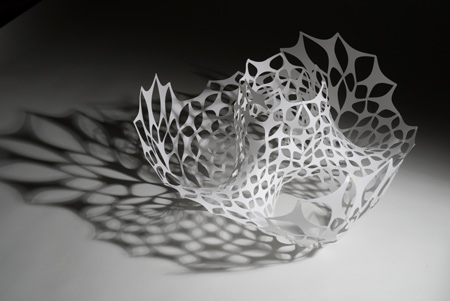
A computer-generated form was converted into modular sections, which were cut from 1.5mm birch plywood using a CNC routing machine. Emphasis was placed on limiting the number of unique module shapes in order to simplify construction; twenty six unique units are used in total, repeated through the symmetry of the form. Richard and Liam see this sculptural piece as a step towards the creation of a larger body of interior installations and functional objects.
Material: 1.5mm Birch Plywood, Stainless Steel bolts, Wingnuts.
Designer: Liam Hopkins and Richard Sweeney
Function: Lighting
Size: 1400mm X 800mm