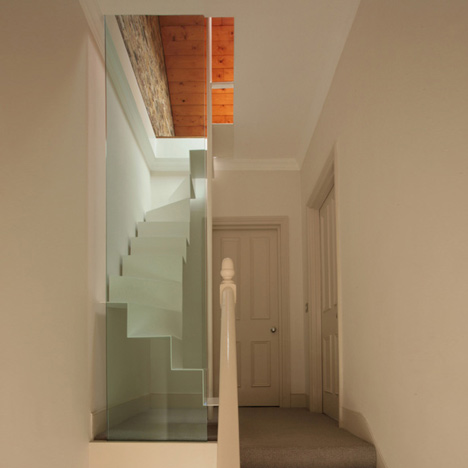
London studio Tamir Addadi Architecture have inserted a tiny staircase to access a tiny loft in a London house.
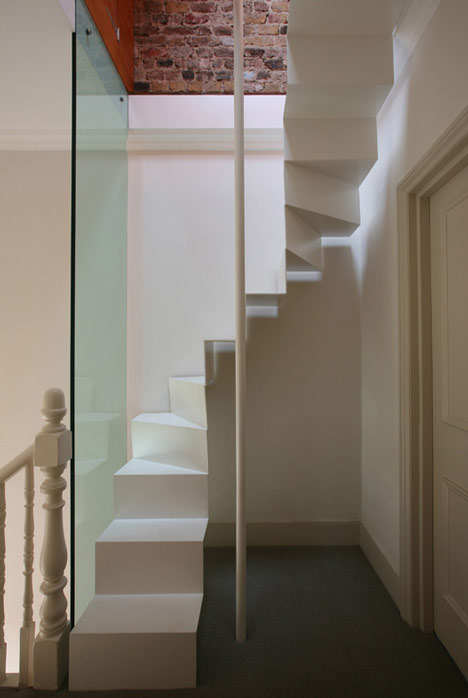
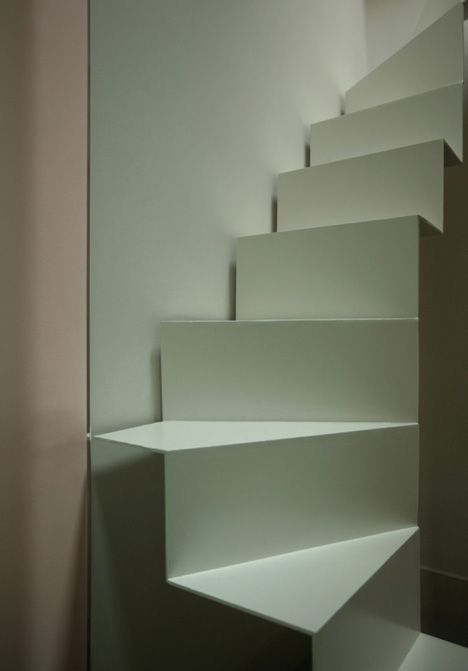
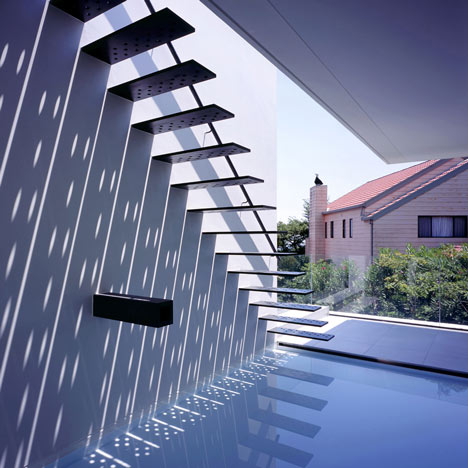
The painted steel staircase has been slotted into a 140 cm x 90 cm space on the landing.
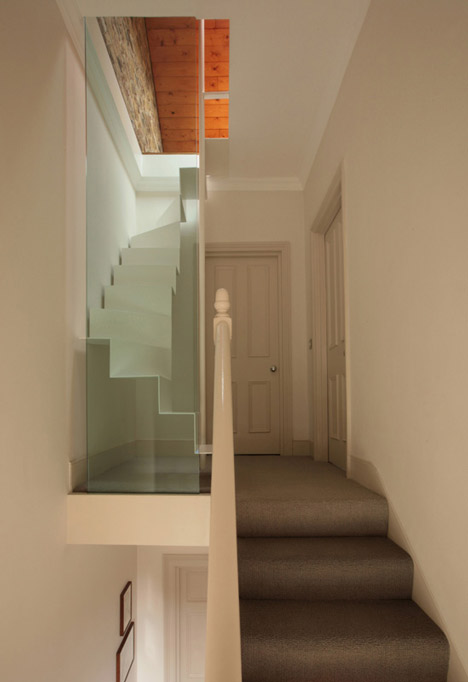
The self-supporting stairway is separated from the walls by a narrow gap while a free-standing steel pole serves as a handrail.
See more staircases in our Dezeen archive.
Here's some more information from the architects:
Tamir Addadi Architecture
Loft access, London
Completed 2010
The client asked us to replace the ladder to the loft with permanent stairs in order to improve the connection of the loft to the rest of the house, as he decided to start using it as a study. The main challenge was to design a staircase for the narrow space of 140 cm x 90 cm.
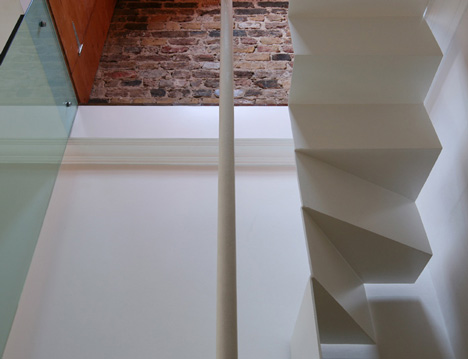
We found it important to come up with a design solution that would help integrate the two differently designed floors – the wood-clad loft with its clean modern lines, and the carpeted Victorian lower floor with its engraved banisters - without disturbing each of their distinctive characters.
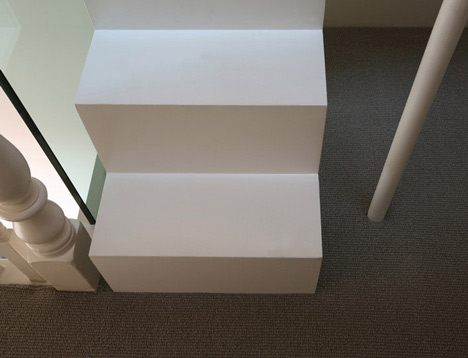
We aimed to achieve this by designing three minimal and separate elements that function together as a staircase but remain abstract in shape, and can be seen almost as pieces of furniture that have been placed in the space – rather then a fixed feature of either the lower or upper floor.
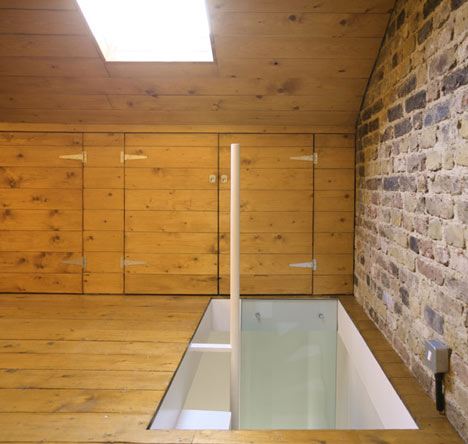
One result of widening the opening to the loft was an increase in the amount of natural light coming in from the loft’s skylight into the originally quite dark landing of the lower floor.
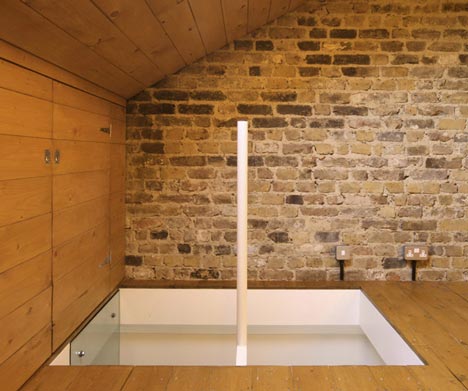
The narrowness of the stairs and the fact that they are slightly removed from the wall contribute to this effect, as they let some light in all around them.
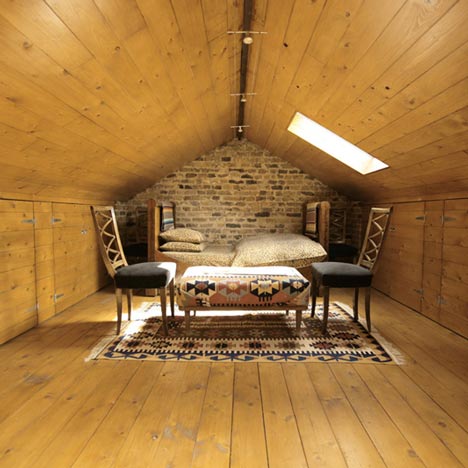
Improving the flow of light was also another way of strengthening the connection between the floors and making it more inviting to use the staircase and climb up into the loft.
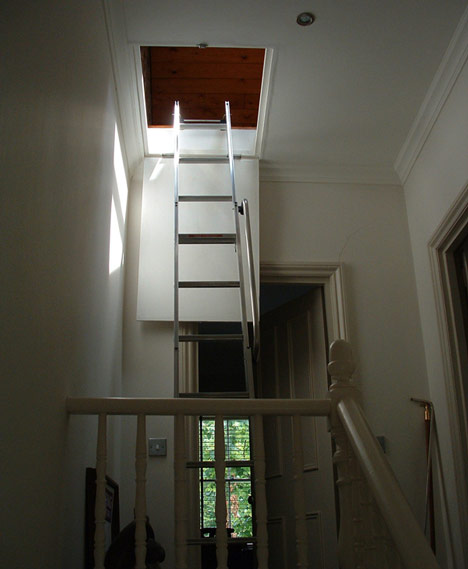
Materials: 6mm welded and painted steel sheet, 50mm painted steel post, 20mm toughened glass.
See also:
.
![]() |
![]() |
![]() |
| Residence in Kurakuen by NRM-Architects Office | More staircases on Dezeen |
More interiors on Dezeen |


I so wish I had a landing and a loft so i could add one of these to my own home. Totally fab – thanks!
and no fire regulations… do love it though
Beautiful minimalistic solution, in contrast to the existing staircase! Don't blindly take the wrong side down the stairs though.
i could clearly say, it's awesome. lad-loft!
Genius! I love it!
Very nice! Just hope building regs don't see it, violations aplenty!
It is a secondary staircase, therefore is not subject to building by-laws.
really? hmm… things they do not tell you in architecture school. depends on location i'm sure though
could have at least photoshopped a balustrade on the loft image before publication…
love the design, but I wonder which staircase was saver
It looks too lovely to be legal!
I'm not an architect in the UK and wonder how can you get away with not complying with building regs? Can you?? Isn't it risky?
Two aspects of the regs come into force on this stair. Regarding fire regulations, in theory there should be a door to separate the loft space if it is classed as a habitable room (which strictly speaking it should be). If it remains classed as ancillary then a door is not needed. As the building is an existing one, the important aspect is to improve overall safety, rather than stringently meet the requirements of the approved documents, and therefore the door requirement could be avoided if , for example, a full house mains supply battery back up smoke and heat alarm system is installed. All this needs to be negotiated in advance with the Building Regs inspector.
Regarding preventing injury through falling, the stair does not comply. Lack of guardrail to loft, distance greater that 100mm between treads and pole/rail. Lack of handrail outside outside is arguable as the pole in the centre may be said to act as such.
I guess there is no Completion Certificate. Building Regs could seek enforcement for I believe a period of one year, after which if they have not acted then the situation is deemed lawful though not in compliance. A Regularisation Certificate could only be obtained by bringing the stair into line with Regs. As long as the situation is one of the clients making, I believe the architect will not be liable for third party injury, as long as the client is advised in writing that by not seeking to make the stair comply then they (the client) are knowingly taking liability for third party injury (guests, tradesmen etc).
If anyone knows if any of the above to be incorrect please post.
Its like a part 3 question this……!
What determines a habitable room in such a situation, 1020×0?
Can you even stand up fully in the loft? It looks pretty low?
(very nice though)
I have to agree it does not comply with UK regs as I know them….pity as it just shows we are totally over regulating our lives where by we forget to be cautious and take care with how we move in our environments…. this is a beautiful stair and by the look of it quite safe and easy to negotiate
I agree with Peter 100% – life is meant to be lived not regulated!
I have lived in London but currently live in Copenhagen where there are many examples of built environment which wouldn't comply with UK regulations; it makes for a wonderfully liveable city where people pay attention to their surroundings and take responsibility for their own safety (eg. pedestrianised streets where cars drive slowly and pay attention to cyclists and pedestrians, cyclists pay attention to pedestrians and pedestrians just pay attention. It's a heirarchy where the ones most likely to damage others also are the ones who have to be the most carefull).
Can anyone please tell me how high these stairs are? How are they fixed above?