


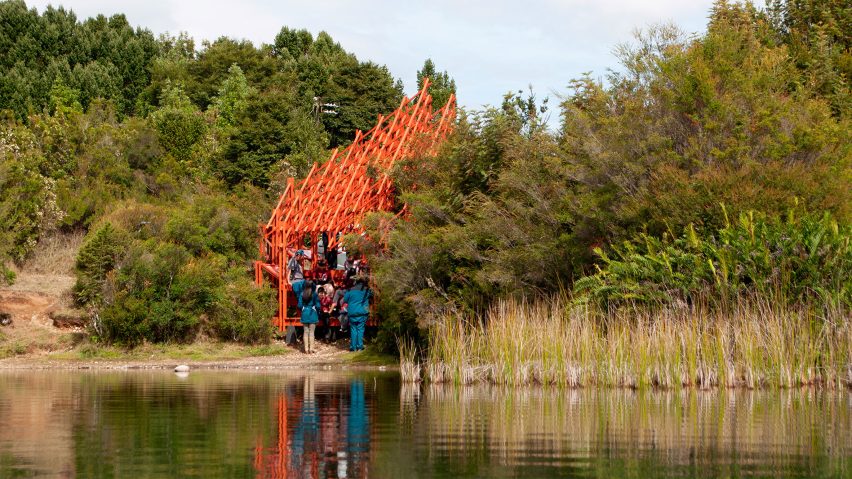
Architecture studio Dum-Dum Laboratorio de Arquitectura Avanzada has created a waterside pavilion out of red painted wood that serves as an environmental classroom for the local community in Calbuco, Chile.
Named Mirador Interpretativo Laguna Troya, or Troya Pavilion, the 38-square metre (409-square foot) lakeside pavilion serves as a space was designed as a space foe education and observation of the wetland ecosystem.

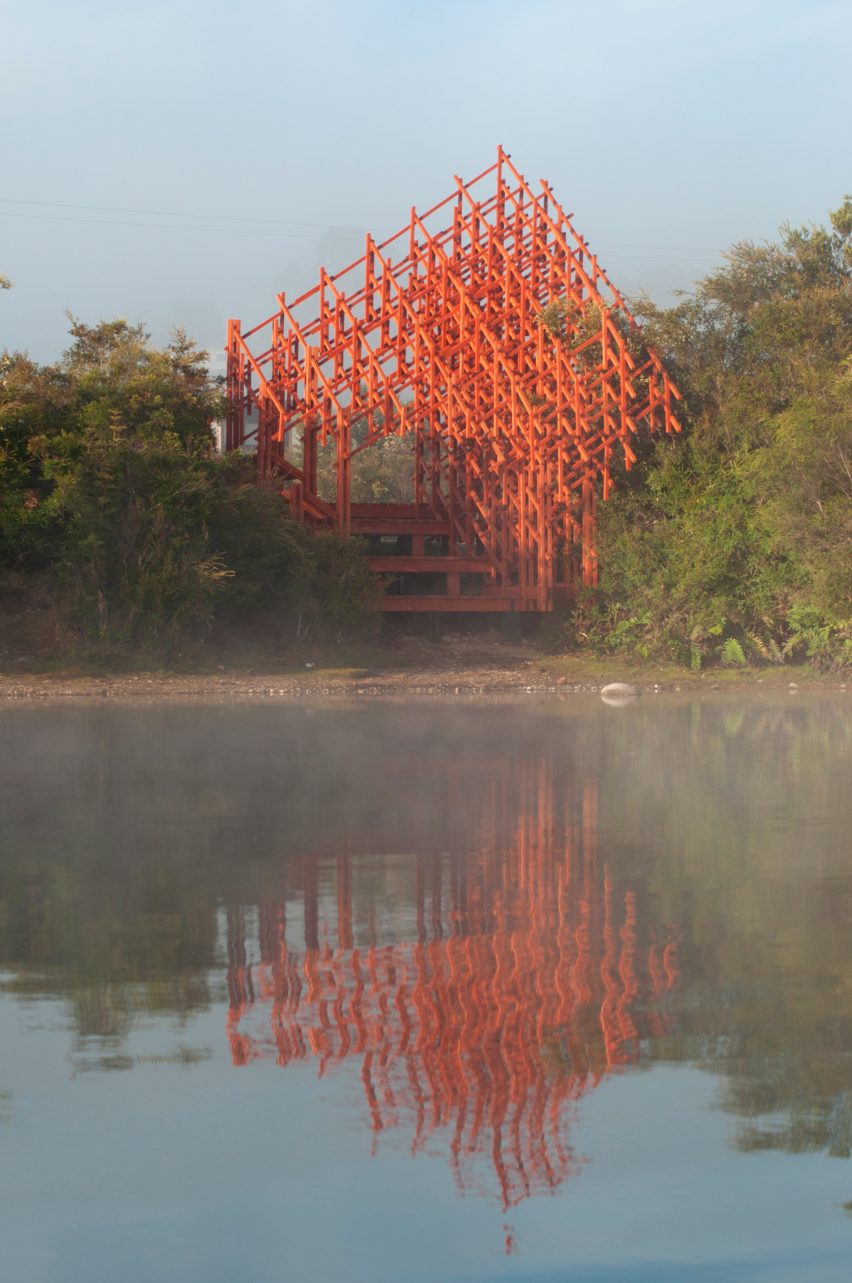
Completed earlier this year, the pavilion continues the studio's investigation of computational design processes that translate into construction systems with discrete fabrication logic.
The studio's system aimed to make the most of limited fabrication tools and resources, relying on small timber elements compounded to replace large structural members and to create varying degrees of enclosure and openness.

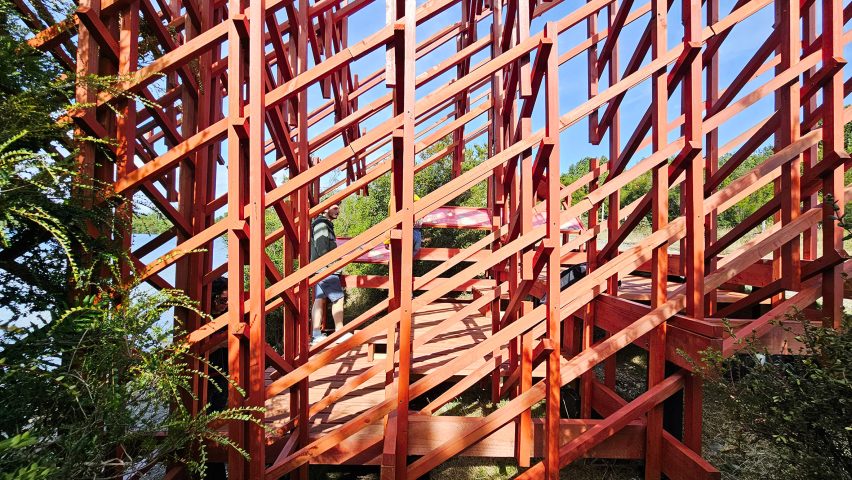
"From this programmatic intention, the project evolved into a porous architectural system that frames and mediates the surrounding landscape through an inhabitable stereometric cloud, where small-scale timber elements collectively generate spatial, structural and environmental conditions," Dum-Dum Lab co-directors Francisco Calvo Castillo and Katherine Cáceres Corvalán told Dezeen.
"This logic allowed us to create a structure that simultaneously functions as a lookout point, environmental classroom and permeable shelter framing views toward the lagoon," the studio added.
Arranged in a diamond patterned lattice, the small-scale timber elements were transported and assembled without sophisticated machinery. Selected for its environmental performance and versatility, the wood's material logic also informed the geometry of the pavilion.
"Rather than concealing connections, the pavilion emphasizes the visibility of the constructive process itself," the studio said.

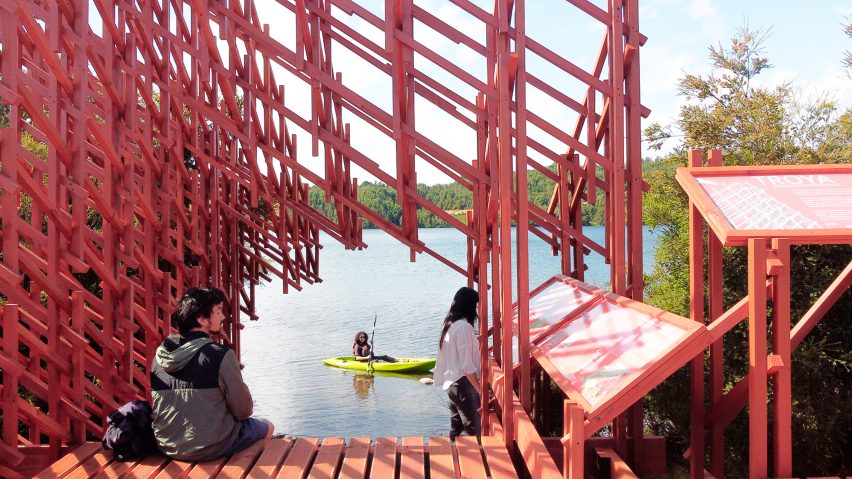
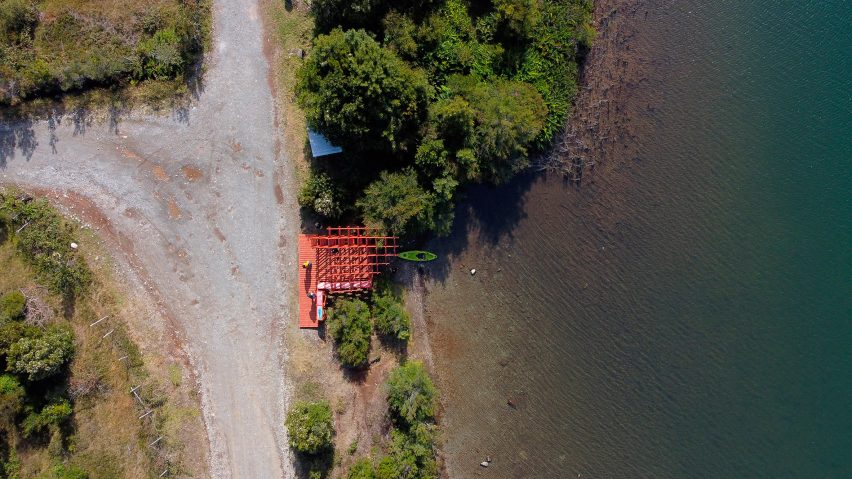
The pavilion is composed of a small boardwalk on the river bank that steps down to three small platforms that serve as bleachers looking out across the water.
Dense foliage forms the boundaries on either side, and the pavilion is perceived as a floating red lattice from the water.
The team found that one of the main challenge of the design was balancing structural stability with permeability, having to carefully calibrate the density and positioning of each element to achieve more rigidity and openness.
However, the processes taught the designers how the discrete system could create environmental sensitivity and spatial richness without large-scale operations.
The porous geometry was designed to establish a reciprocal relationship with the site in which vegetation, birds and the climatic elements of water, wind and light integrate into the structure over time.
"The project encourages engagement with the surrounding biodiversity while minimizing physical impact on the terrain," the studio said.
"Developed in close collaboration with local organizations connected to environmental education and ecotourism, the pavilion also incorporates scientific illustrations of native flora and fauna by scientific illustrator Sol Pacheco as part of a broader effort to promote awareness of the wetland ecosystem."
Other recent pavilions that use similar construction logic include a timber structure shaped like a cube on the outside and a sphere on the inside by Waugh Thistleton Architects in Istanbul, a stone and wood pavilion reminiscent of ancient building forms in Sicily by Leopold Banchini Architects and a husk-like kiosk with a facade that opens like a seed pod by Walden Studio in the Netherlands.
The photography is by Katherine Cáceres and Pamela Villamar.
Project credits:
Client: Creación Artística Fondart 2025
Design Team: Francisco Calvo, Katherine Cáceres, Juan Luis Marín
Illustrator: Sol Pacheco
Construction team: Pamela Villamar, Rosina Viotto Bergmann, Juan Peña, Florencia Verdugo Silva, Camila Vera Llanos, Mauricio Santana Münzenmayer, Bernardo Marín
Collaborators: Concón Maderas Impregnadas