


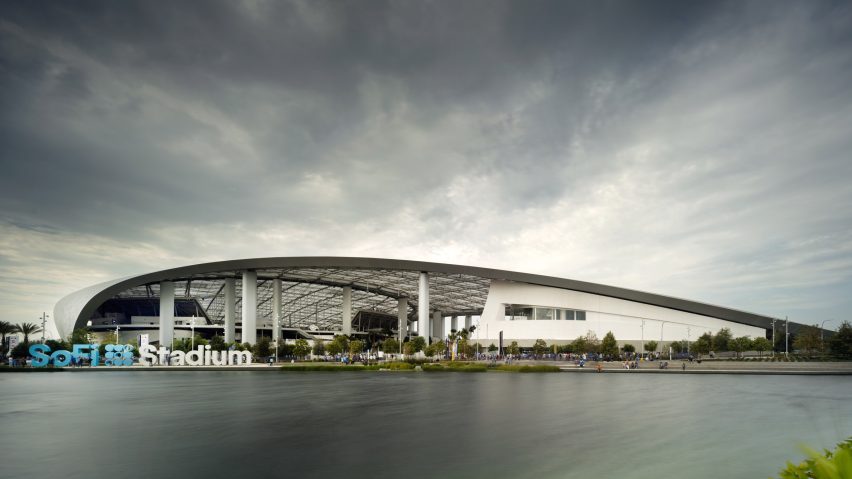
Continuing our Future Stadium series, we take a close look at SoFi Stadium in Inglewood, California. Designed by US studio HKS, it has one of the world's largest videoboards and the highest price tag in the history of sports architecture.
The HKS-designed stadium set the standard for technology-centred sports stadiums on a global scale, and it has grabbed attention as one of the venues for the 2026 FIFA World Cup.
Opened in September 2020, the 300-acre sports and entertainment district comprises the 3.1 million-square-foot (28,000-square-metre) stadium and a private development known as Hollywood Park on the site of the former Hollywood Park racetrack. It was built primarily for use by the NFL.

Home to both the Los Angeles Rams and the Los Angeles Chargers, the venue has hosted Super Bowl LVI, the 2023 College Football National Championship and matches in the 2026 FIFA World Cup and is slated as the site of the Opening and Closing Ceremonies of the 2028 Olympic Games.
The $5.5bn indoor-outdoor stadium seats approximately 70,000 people with 260 luxury suites and 13,000 premium seats, and it can be expanded to a capacity of 100,000 people. The building also features 12 club spaces and seven suite experiences. It is the most expensive stadium in the world.

"First and foremost, we wanted to create an environment that immersed people into technology," HKS partner and executive vice president Mark A Williams told Dezeen.
"We knew this site, in the entertainment capital of the world, was going to be more than a place to watch football, so we created a global stage early on."
"You can feel the ocean breezes go across your face"
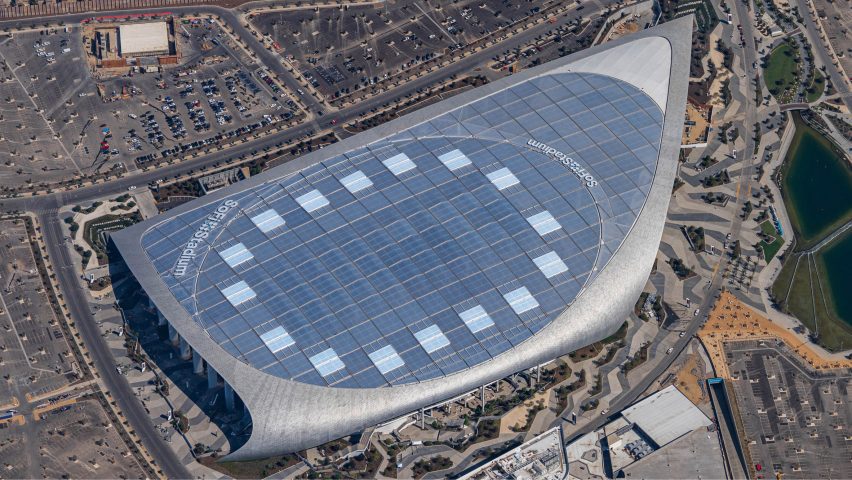
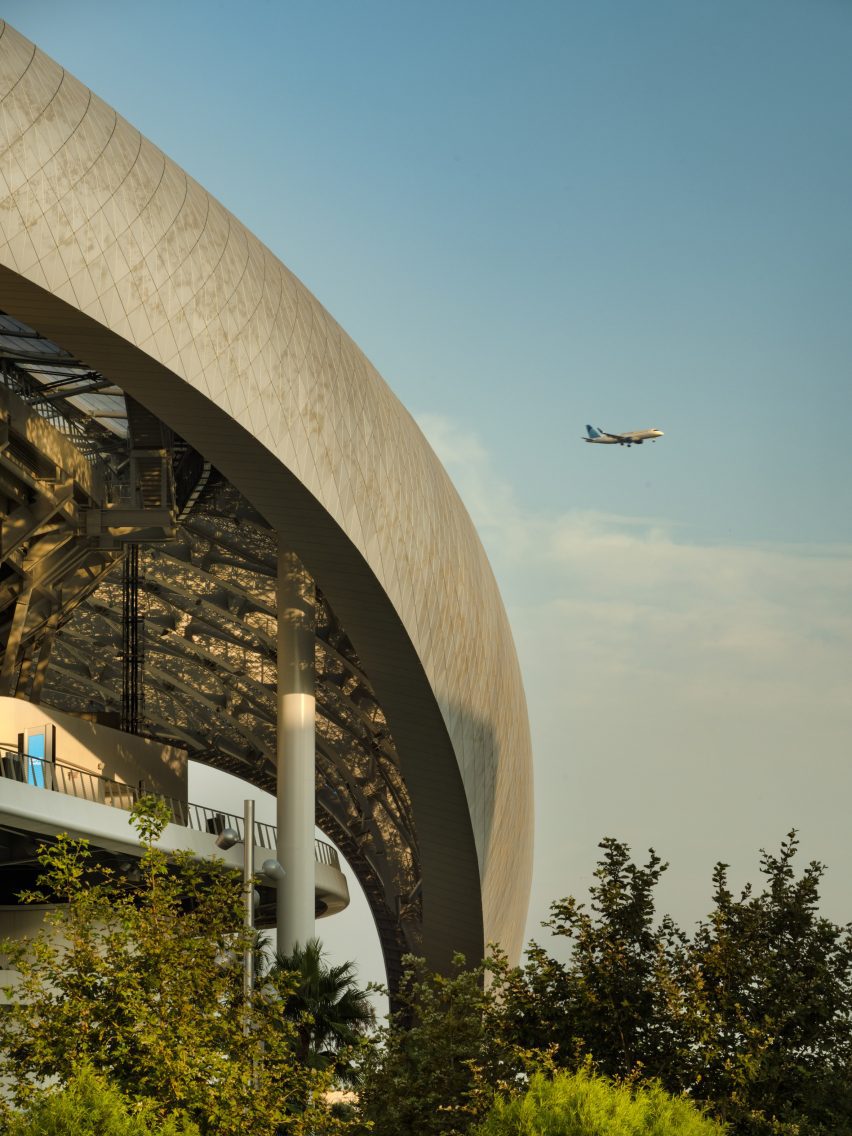
Crowning the complex is a cresting wave-like roof canopy that shades the stadium, 2.5-acre American Airlines Plaza and the 6,000-seat YouTube Theater.
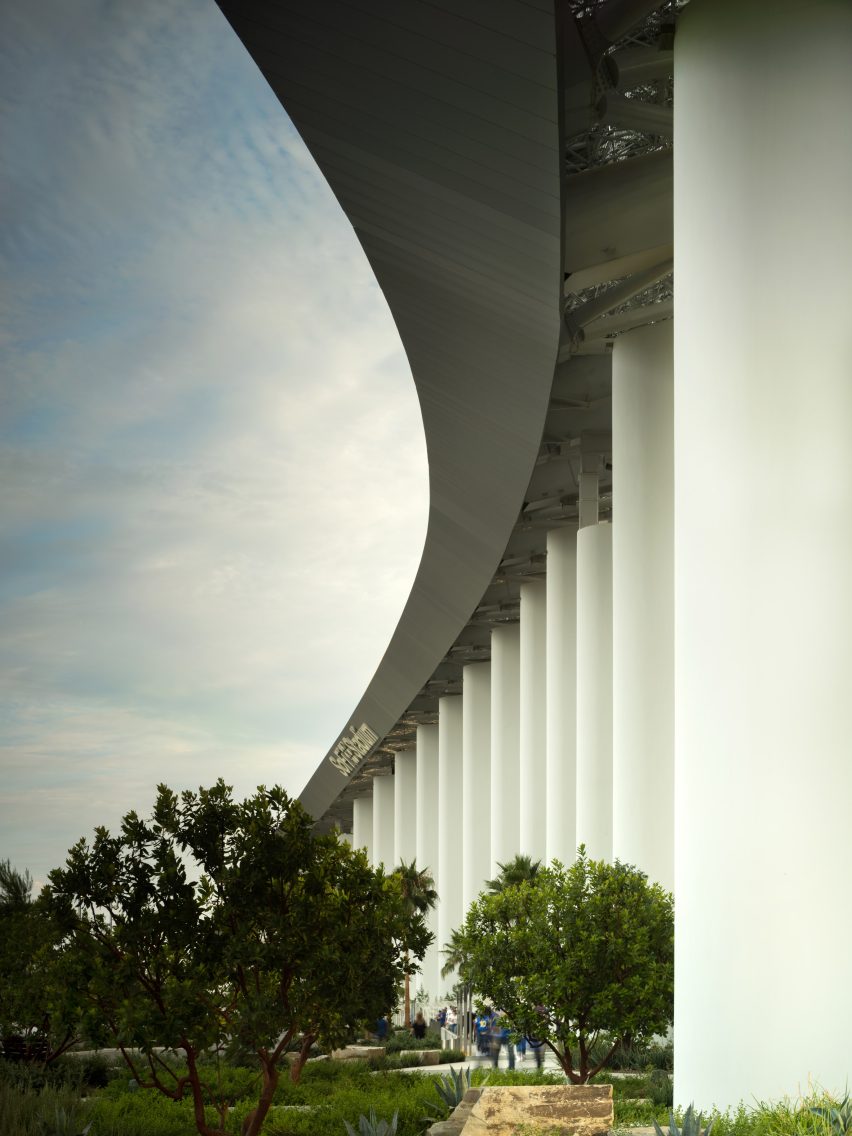
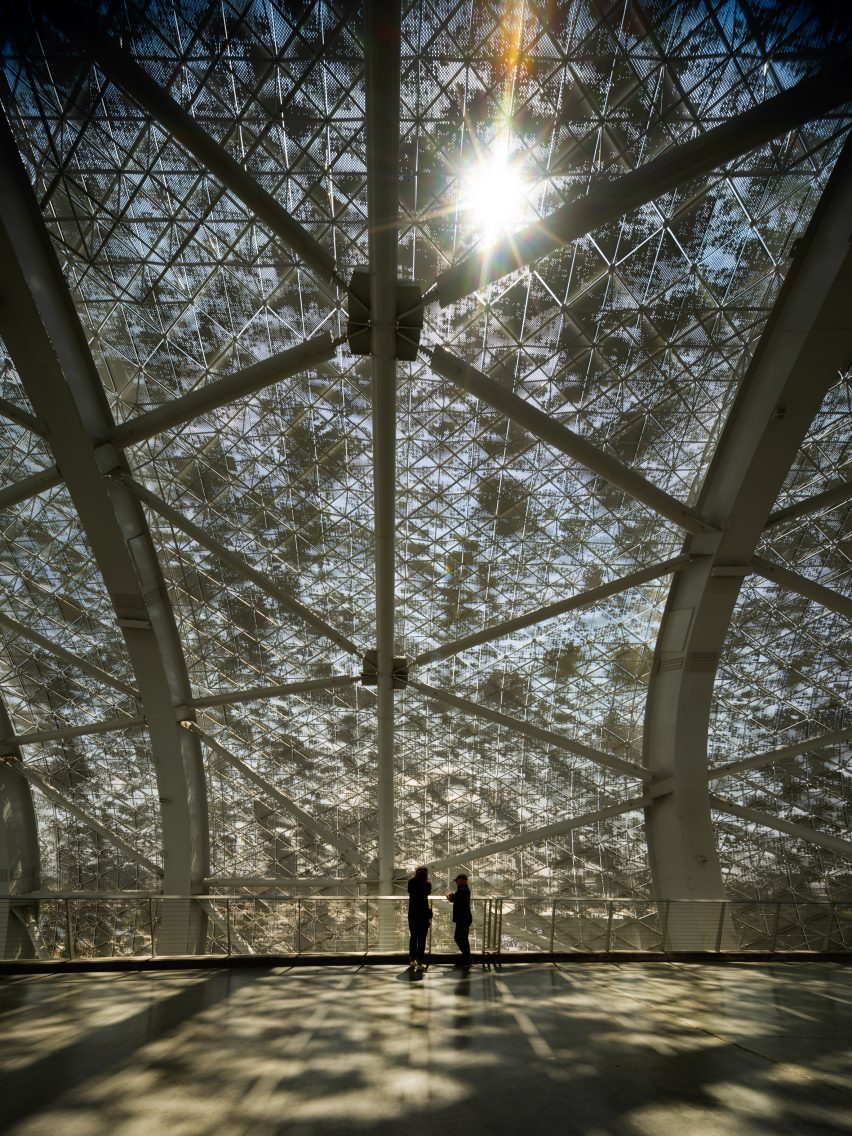
Resting on blade columns, the transparent canopy consists of a structural steel shell with a compression ring, a cable-net system and a lightweight, transparent plastic called ethylene tetrafluoroethylene (ETFE) that stretches over the structure.
Thirty-one preassembled steel pieces form the shell and ring, which required the use of one of the world's largest cranes to hoist the roof. Within the shell, 1,800 tonnes of cable – measuring 17.8 miles (29km) – create the largest wire frame cable system in the world and the first of its kind in the US.
Over that, 309 ETFE panels – measuring 1,200 square feet (111 square metres) each – make up the outer layer of the roof with 90 per cent of the strength of glass, but at only one per cent of the weight.

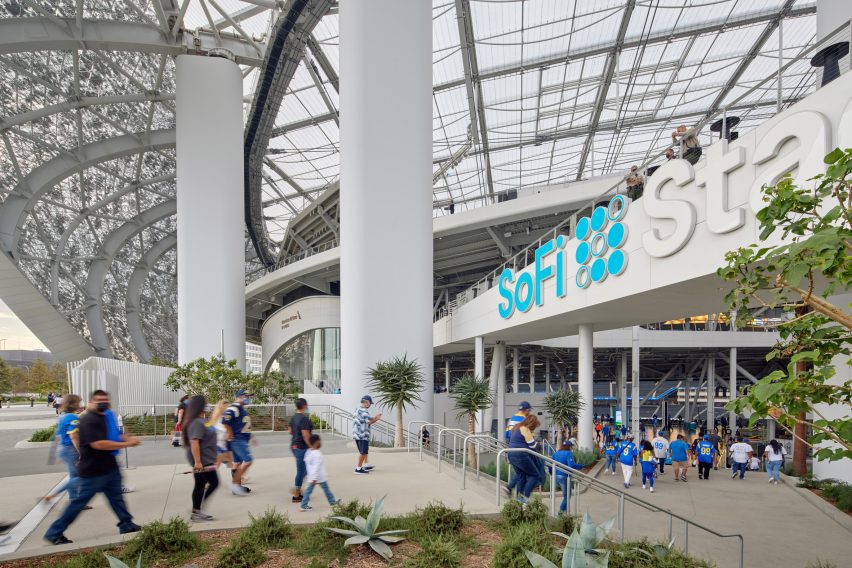
Calibrated to the climate of the site, 46 operable roof panels open to release hot air, while 14 asymmetrical picture frame panels open on the east and west sides of the canopy to draw air into the space, lowering the ambient temperature of the facility by 4 degrees Fahrenheit (2.2 degrees Celsius), despite its open-air structure.
"We tuned the building based on 100-year historical climate data from LAX and Hawthorne airports that we analyzed and used to shape the building," Williams explained, noting that the upper seating bowl of the stadium has sensors that read the temperature and humidity inside the building.
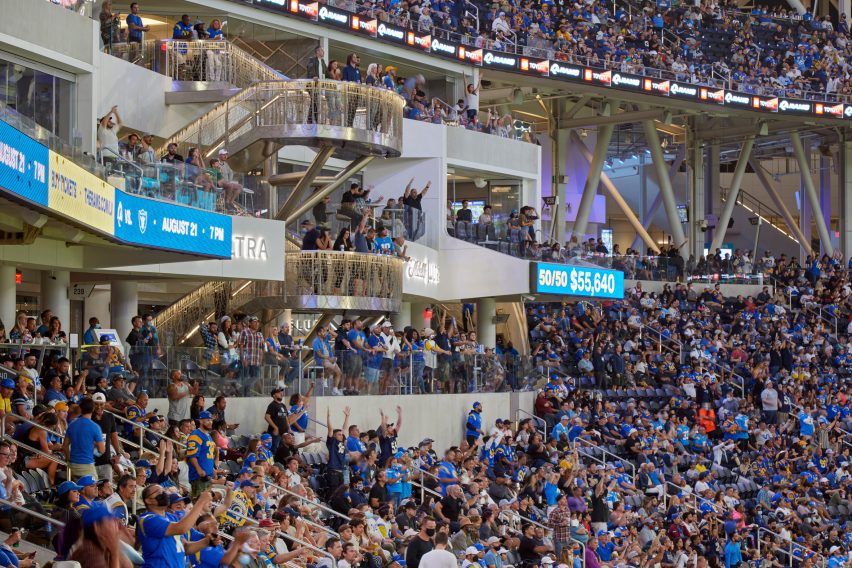
"With the incredible climate that Southern California offers, you can feel the ocean breezes go across your face when you're in the seating bowl."
If that weren't complex enough, HKS placed video technology disks across the outside of the roof, turning the canopy into a video screen. Because it's located just 3 miles (5km) from Los Angeles International Airport (LAX) and on axis with the airport's runways, the 76.5 million travellers flying in and out of the city annually can see live-streamed footage, sponsorship messages or promos as they land.
A videoboard like no other
The exterior is only the first sign of the stadium's deep relationship with digital technology.
When it opened, SoFi Stadium featured the largest videoboard ever created in sports, according to HKS. Weighing 998 tonnes, the 70,000-square-foot (6,500-square-metre) digital LED screen is the first-of-its-kind, dual-sided centre-hung videoboard.
Known as the Infinity Screen by Samsung, the 4K end-to-end videoboard is 1.2 times longer and 1.5 times wider than the field itself, with panels that range from two to four storeys tall, hung 122 feet (37 metres) above the playing field, but suspended 70 feet (21 metres) below the roof canopy.

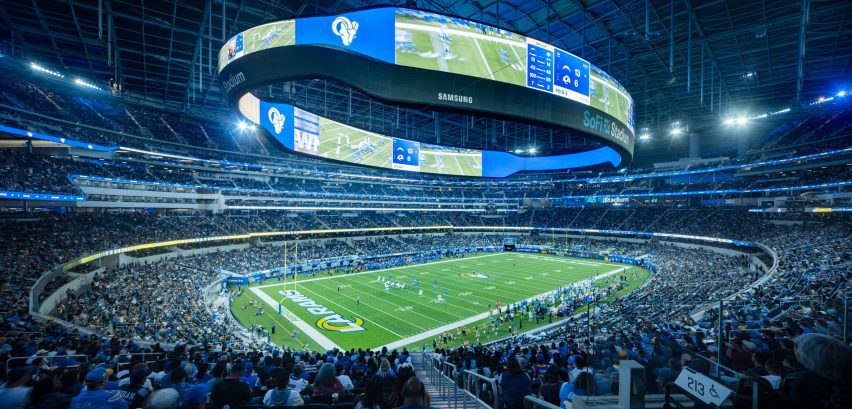
In the largest graphics control system in the history of sports, according to HKS, the oval display features 80 million pixels spaced 8 millimetres apart that can be uniquely or congruently programmed with live video feeds, statistics and animated content.
With more than 260 embedded speakers, the Infinity Screen has the wattage equivalent of 1,500 home theatre systems. Additionally, matrix boards run around the edge of the seating bowl, carrying a scrolling ticker tape of information around the space.
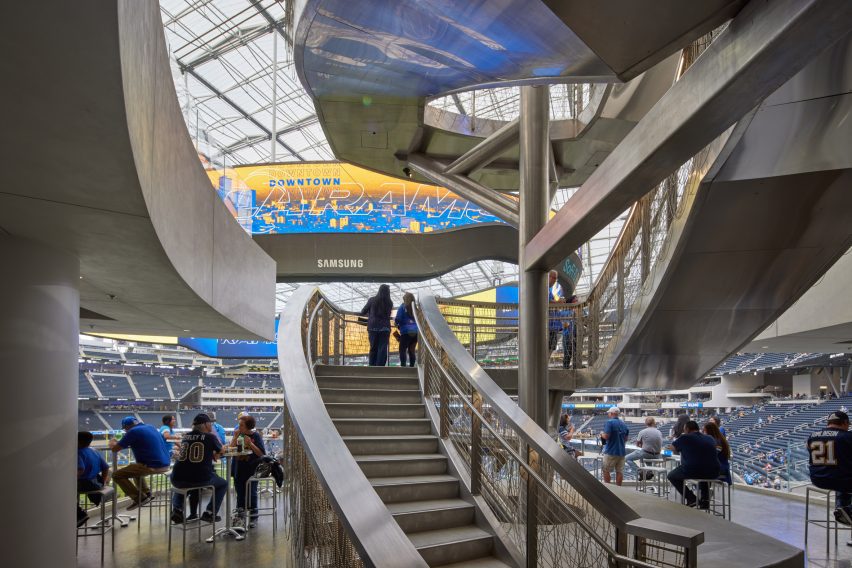
"We thought a lot about how individuals consume entertainment, data and information," Williams said, explaining that the team wanted to incorporate how visitors function daily – using multiple devices feeding a constant stream of content – into the design of the building.
"Nothing beats live entertainment, but we wanted to augment the experience with other data to broaden and heighten that from day one."
Tracking technology
Integrated technologies permeate every moment of a visit to SoFi Stadium. Before they arrive for events, visitors download the SoFi app that holds mobile tickets, parking passes and navigational maps.
In 2022, the venue partnered with Evolv Technology to integrate artificial intelligence-based (AI) security screening tools. Rather than standing in long queues to empty their pockets and flashing clear purses, visitors walk through AI-based weapons detection sensors when they enter the stadium.
Once inside, visitors can purchase concessions and merchandise with their cell phones and collect food and beverages from kiosks with a simple tap, reducing lines, waiting times and preserving valuable time watching games and performances.
"You are never disconnected from the global stage," Williams said, noting that the process of attending an event has been elevated with more efficient flows.
"SoFi Stadium shows how a building can have personality," he said. "[The building] becomes its own identity and it augments the experience you have."
One of the global leaders in sports and entertainment architecture, HKS is currently designing a colonaded stadium for the Washington Commanders, a winged layout for the controversial Cleveland Browns venue and a Maori-inspired sports landmark for the All Blacks rugby team in Auckland, New Zealand.
The photography is by Nic Lehoux and Bruce Damonte.
Project credits:
Developer: StadCo LA
Architecture and master plan: HKS
General contractor: Turner/AECOM Hunt JV
Owner's representative: Legends Project Development
Landscape architecture: Studio-MLA
Structural engineering: Walter P Moore
Civil engineering: David Evans and Associates
Services and MEP engineering: Henderson Engineers, Inc.
Cable roof and structural cooperation: Schlaich Bergermann Partner
Geotechnical & excavation contractor: Kiewit Corporation
Digital transformation & integration: Deloitte Digital
Sustainability consultant: Honeycomb Strategies
The Infinity Screen by Samsung: HKS, Samsung, HARMAN brands, Wrightson Johnson Haddon and Williams Inc. (WJHW), Pro Media Audio and Video

Future Stadium
This article is part of Future Stadium, our series exploring the growing role of monumental sports buildings in architecture and urbanism around the world.