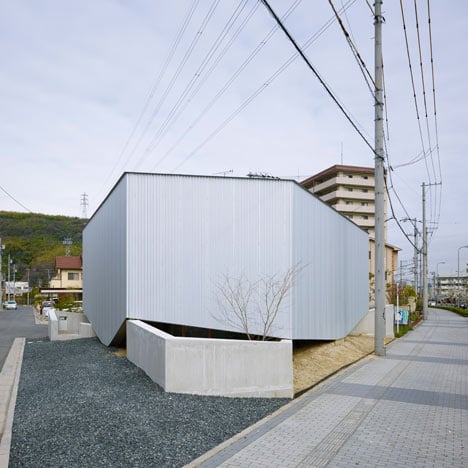
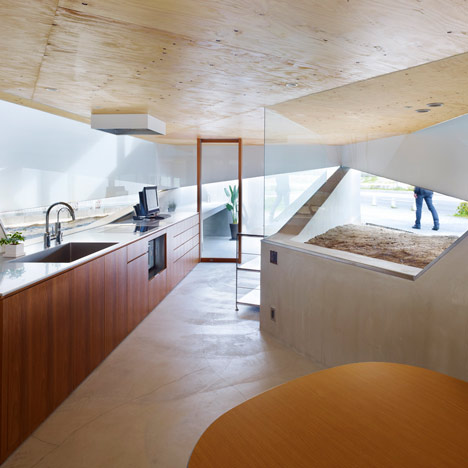
The raised corner of this house in Hiroshima by Japanese architects Suppose Design Office allows light to creep into the interior.
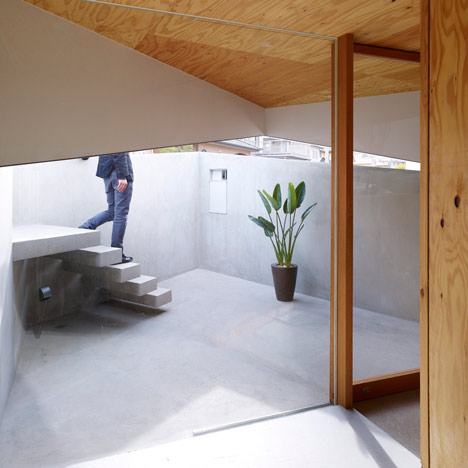
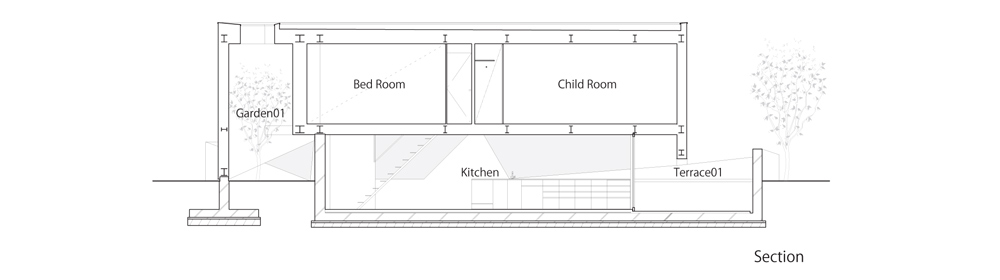
A cantilevered staircase leads down to the sunken main entrance.
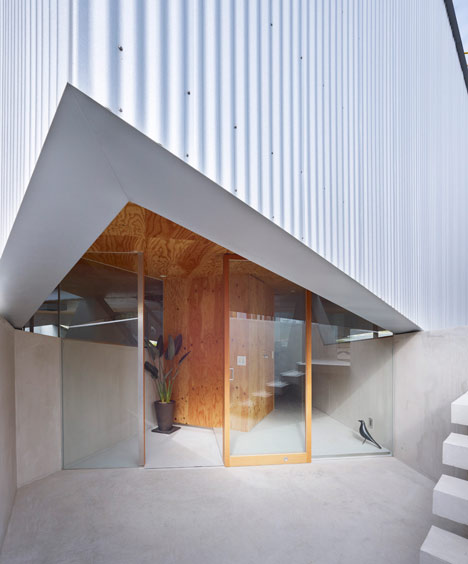
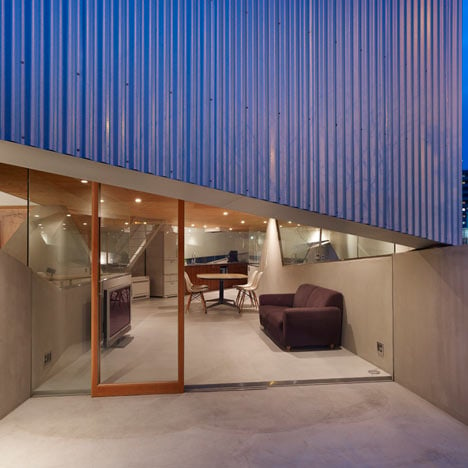
The ceiling of the entrance thrusts outward over a small courtyard.
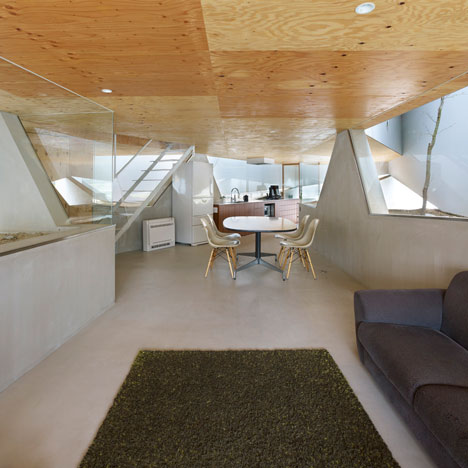
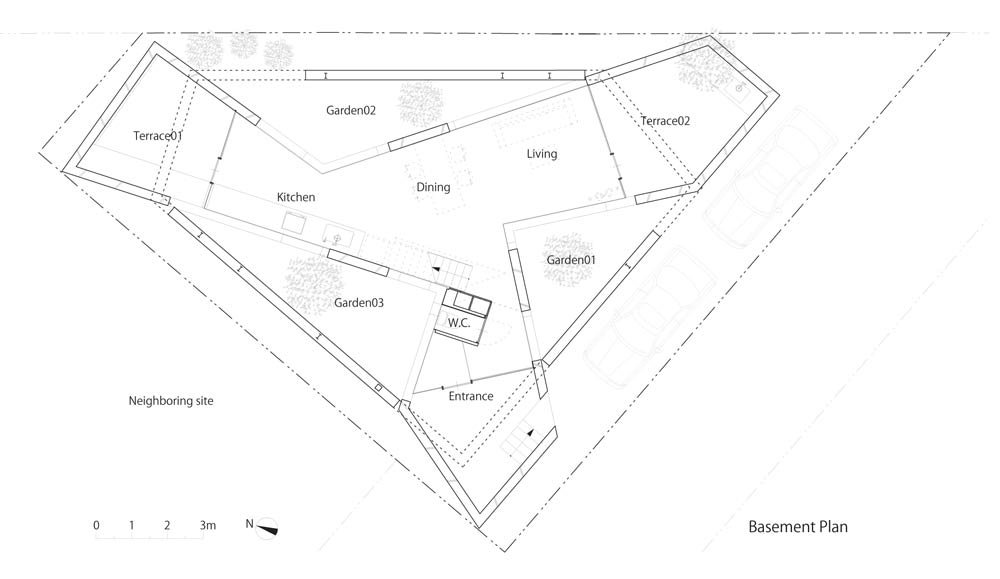
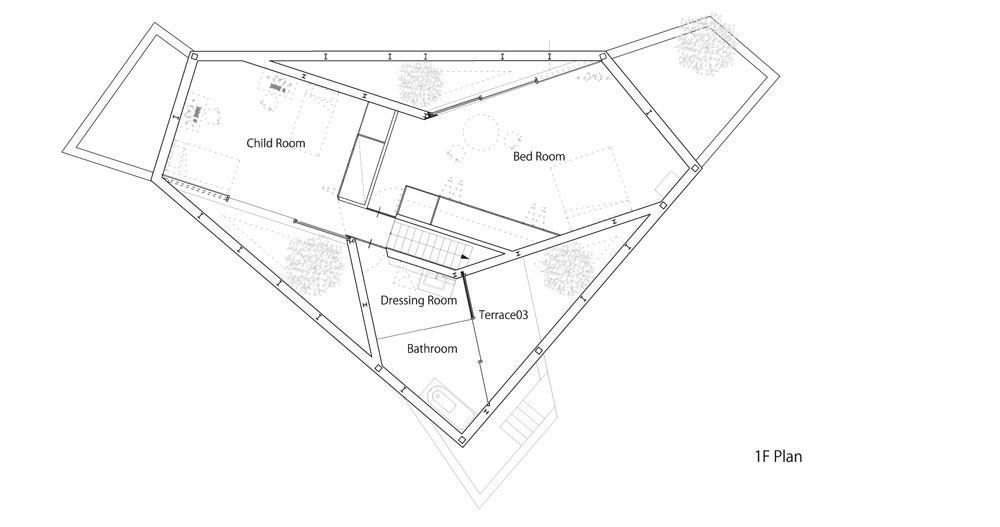
The external structure wraps around three courtyards, shielding them from the street outside while allowing light to enter through the gaps underneath.
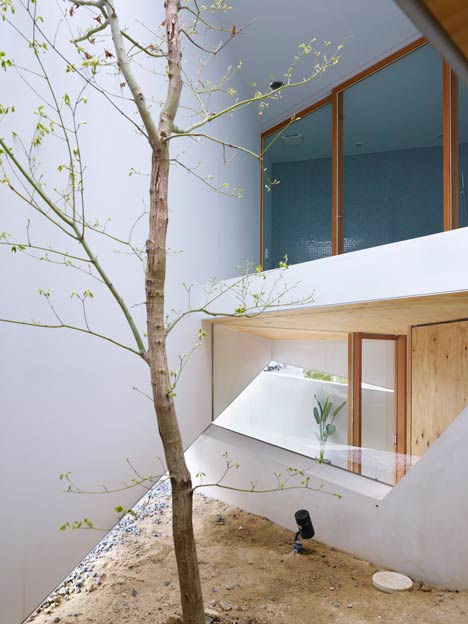
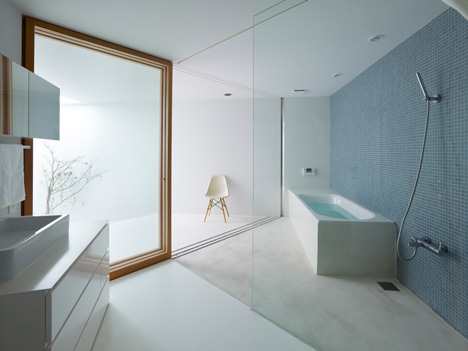
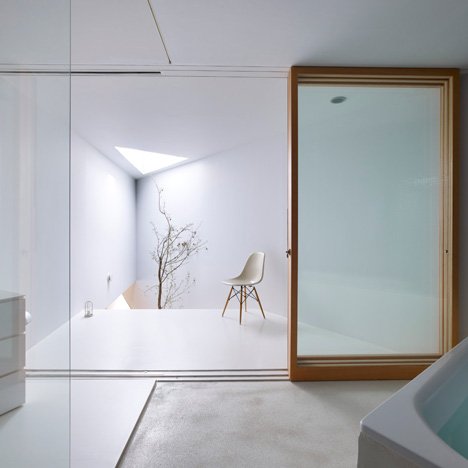
Trees planted at ground level can be seen from windows in the upstairs bedrooms and bathroom.
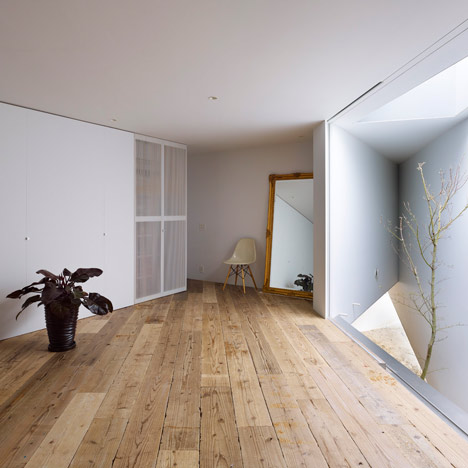
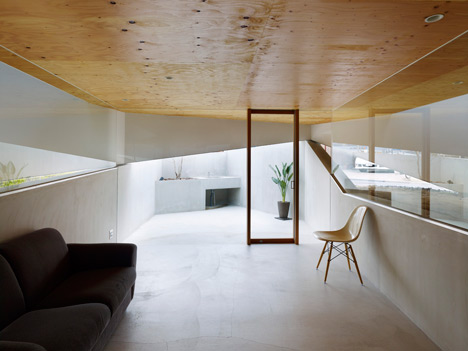
The angular interior spaces are dictated by the building's restricted footprint.
Suppose Design Office have completed a number of other homes in Hiroshima including one with wooden volumes sprouting from a central core and one with triangular terraces squeezed into the space between the inner and outer walls.
See all of our stories about Suppose Design Office.
Click above for larger image


Wow, honestly I'm speechless right now. That's such a lovely design. And there's so much light and privacy.
Masterful…it took my breath away.
Wow! So twisted, so beautiful!
Seems like a collapsed building with tiny cracks at the basement. Perhaps contextually suitable.
I want it around my face, under my feet, in my eyes!
trying to make a town, or a neighborhood in Japan must be considered a lost battle. all these very talented dudes overthere are making lots of completely opaque gems where they block every reference to the surrounding society, and where they create little private arcadias to be alone with yourself. they seem to express that living in the land of the rising sun is an almost unbearable load to carry nowadays.
I usualy dont comment, but I needed to do it. This is poetry. (period)
poor trees
Quite beautiful, but the ground floor is unpleasant. No clear views so it feels like it's made for children. The photographs doesn't help as you always look right above the windows and into a wall.
modest enough from outside, but amazing from inside!
art and tecnic! perfect house!
to echo Rob's sentiments – it is interesting to note the abundance of introverted architecture that is coming out of Japan. There is exquistie complexity though in the designers ability to omit the streetscape while still harnessing the natural resources of light and air.
Hmm!….if you have a family of four and designer is showing you this kind of architectural concept for a home with one chair and one sofa in a generally empty space, so that is why you should avoid such technical and unlivable construction.
And where are the toilets!!!
Japanese architects are like magicians. Their photographs generally do not reflect the lifestyle and everything seems to have disappeared. For example a typical Japanese household has many utensils, plates, crockery thus needing a huge dish rack. We have seen too many Japanese kitchens where there is only a sink and minimal cabinets. Unreal or they are great at making things disappear!
I'm not sure what tradition or architecture you (Jasper and Joanna) are comparing it to, but it's quite common across all cultures for architectural photography to be handled by the architect after the house is completed and before the residents have moved in, thus most new homes you see photographed are staged with furniture the architect or his photographer brings for the shots, which is understandably kept to a minimum. That's clearly the case here, as you see the same chair appear in nearly every shot. It is, I think, an unfortunate tradition, because it results in such unrealistic impressions of the day-to-day life of the space, but there's nothing unique to Japan about it.
Also it should be noted that japanese kitchens in general are very modest – not the double sink, island in the middle, hero rangehood, 8 burner cooktop monsters that the west tend to favour.
windows! air! light!
this looks like a really beautiful dungeon.
(if you think that no right angles makes for beautiful living, that is.)
this isn't just introverted, it feels a little repressed.
I think it's beautiful, but I agree. As a tall person, it makes me want to duck just looking at the pictures!
like a pearl in a shell. beautiful. thanks
Creo que la arquitectura japonesa no se cierra hacia la calle. Al contrario, si uno observa las obras de Toyo Ito, éstas se abren y se integran al paisaje urbano